
Starting tv series game of thrones season 1 still makes sense because it delivers the strongest foundation the show ever had: sharp political tension, memorable character introductions, and a world that feels dangerous long before the largest battles arrive. Compared with later seasons, it moves with more restraint, but that slower pace is exactly what gives the betrayals, alliances, and family rivalries their weight. For viewers looking to know whether season 1 is worth the time, the answer is yes—especially if you prefer story, strategy, and character stakes over nonstop spectacle.

What is Game of Thrones Season 1 about?
Game of Thrones Season 1 is about the fight for power in Westeros, but the reason it works is simpler than that: almost every major character is trying to protect a family, hide a secret, claim a name, or survive a system they do not fully control. The season moves between the northern stronghold of Winterfell, the royal court in King's Landing, the Wall, and Daenerys Targaryen's exile across the Narrow Sea.
Ned Stark enters the politics of King's Landing
Ned Stark's move from Winterfell to King's Landing is the season's clearest warning: honor is valuable, but it is not the same as political skill. As Hand of the King, he investigates the death of Jon Arryn and quickly discovers that the capital runs on secrets, alliances, and quiet threats.
The Stark family begins to split apart
The Stark family starts as the emotional anchor of the season, then slowly loses the safety that made Winterfell feel stable. Ned, Sansa, and Arya go south; Jon leaves for the Wall; Robb remains in the North; Bran's injury changes the household; and Catelyn begins acting on suspicion and fear.
The separation matters because the Starks are strongest together. Once scattered, each family member has to survive under different rules.
Jon Snow joins the Night's Watch
Jon Snow joins the Night's Watch hoping for purpose and respect, but the Wall is not the noble brotherhood he imagined. It is cold, under-resourced, and filled with men who often joined because they had no better option.
His early arc is useful for viewers who prefer character growth over court politics. Jon has to decide whether he wants status or responsibility, and his friendship with Samwell Tarly shows that his best quality is not sword skill but the ability to recognize worth in people others dismiss.
Daenerys grows into her Targaryen identity
Daenerys begins the season with almost no control over her life. Viserys treats her marriage to Khal Drogo as a bargaining tool for his own claim to the Iron Throne, but Daenerys gradually becomes more observant, more confident, and less dependent on her brother's version of their family history.
Her transformation works because it is not instant. She adapts, learns what power looks like in a culture she did not choose, and begins to define what being a Targaryen means for herself rather than simply inheriting Viserys's obsession.
Who are the main characters in Season 1?
The cast looks intimidating at first, but Season 1 is easier to follow if you group people by pressure point rather than by name alone. The Starks give the story its emotional base, the Lannisters drive much of the danger in King's Landing, Robert's court shows how unstable the realm has become, Jon opens the northern threat, and Daenerys carries the exile storyline.
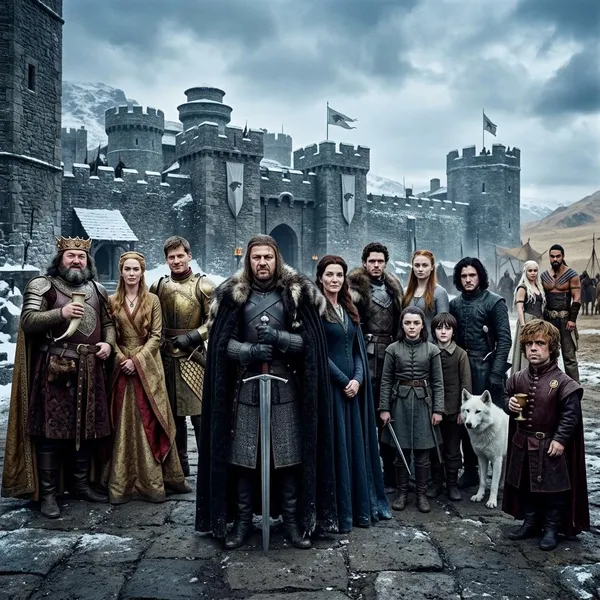
Ned Stark and House Stark
Ned Stark is the moral center of the first season, but House Stark is more than Ned alone. Catelyn is protective and politically sharper than she may first appear; Robb begins to carry adult responsibility; Sansa and Arya show opposite reactions to noble expectations; Bran's path changes after his fall; and Rickon represents the childhood innocence the family is trying to preserve.
Cersei, Jaime, and Tyrion Lannister
The Lannisters are powerful because they understand image, money, fear, and family advantage. Cersei protects her children and position with cold focus. Jaime carries the confidence of someone used to privilege and violence. Tyrion, often underestimated, reads people with unusual accuracy and uses wit as both shield and weapon.
- Cersei: political instinct and maternal ruthlessness.
- Jaime: reputation, force, and Lannister arrogance.
- Tyrion: intelligence, humor, and outsider awareness.
Robert Baratheon and the royal court
Robert Baratheon is king, but Season 1 makes it clear that sitting on the throne does not mean controlling the realm. He is tired, careless with rule, and surrounded by people who are far more alert to opportunity than he is.
The court is where viewers should watch for quiet danger. Joffrey's cruelty, Littlefinger's manipulation, Varys's careful knowledge, and the ambitions of other nobles all show that the kingdom is already unstable before open conflict begins.
Jon Snow and the Night's Watch
Jon's storyline introduces a different kind of power: duty without glamour. The Night's Watch is isolated from southern politics, yet it may be guarding against something more serious than the nobles in King's Landing want to believe.
For viewers who find the throne politics dense, the Wall offers a cleaner emotional thread. Jon has to learn humility, leadership, and restraint while the season quietly builds unease through ranger disappearances, strange corpses, and old warnings that sound less like superstition as the episodes continue.
Daenerys and Viserys Targaryen
Daenerys and Viserys show two opposite responses to losing power. Viserys clings to entitlement and expects loyalty because of his name. Daenerys begins with fear, but she survives by learning, adapting, and earning respect in ways her brother cannot.
The contrast is the point. Viserys talks about restoring Targaryen greatness; Daenerys starts building the strength that could make that idea real.
How does the Season 1 story develop?
Season 1 develops like a tightening trap. The opening episodes teach you the families and locations, the middle episodes turn suspicion into open danger, and the final episodes force nearly every major character into a new position. It is not a season built around constant battles; it builds tension through conversations, choices, and consequences.
Episodes 1–3 introduce the main families
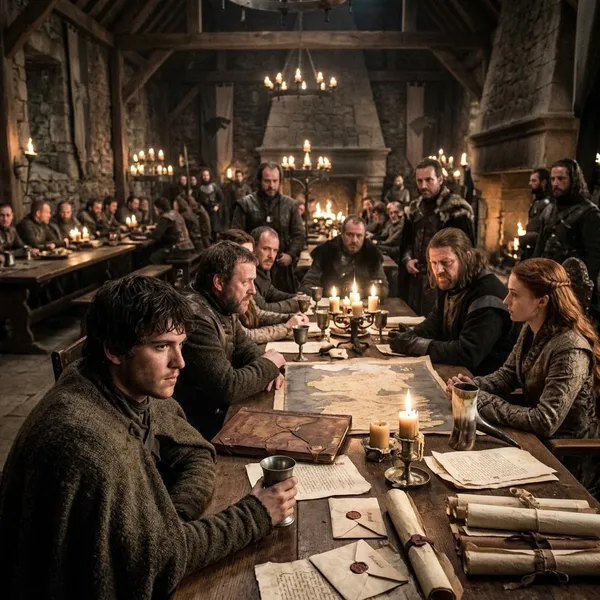
The first three episodes establish the map of the story: Winterfell as the Stark home, King's Landing as the center of royal danger, the Wall as a neglected frontier, and Daenerys's world across the Narrow Sea. They also plant the mysteries that make the season more than simple setup.
- Jon Arryn's death starts the political investigation.
- Bran's fall turns a private secret into a family crisis.
- Daenerys's marriage changes the future of the exiled Targaryens.
Episodes 4–6 deepen the political mystery
The middle stretch is where separate storylines begin to pull against each other. Ned's investigation gains clearer direction, Catelyn's choices increase Stark-Lannister tension, and Tyrion becomes caught in the consequences of suspicions he did not create.
This is also the point where the show becomes more rewarding for viewers who like motives over simple heroes and villains. Characters act from pride, fear, love, ambition, and self-preservation at the same time, which is why one decision can make sense emotionally while still being disastrous politically.
Episodes 7–8 push Westeros toward war
Episodes 7 and 8 move the story from hidden danger to visible crisis. Robert's weakening authority, Ned's discoveries, and the growing hostility between great houses make war feel less like a possibility and more like the result of too many people refusing to back down.
Jon and Daenerys also reach pressure points here. Jon's family loyalty strains against his vows, while Daenerys faces changes that test whether her new confidence can survive loss and uncertainty.
Episodes 9–10 transform every major storyline
The final two episodes are where Season 1 earns its reputation. The biggest turns are not random shocks; they grow out of the rules the season has already taught: information matters, timing matters, and power usually moves faster than honor.
For spoiler-sensitive viewers, these are the episodes to watch before reading detailed discussions online. They change the direction of the Stark story, the struggle for the throne, the Wall storyline, and Daenerys's future in ways that define the rest of the series.
How closely does Season 1 follow the book?
Season 1 is a close adaptation of A Game of Thrones, the first novel in George R.R. Martin's A Song of Ice and Fire series. Most of the central events, character arcs, and major reveals remain intact, which is why many book readers still see it as one of the strongest seasons of the show.
It mainly adapts A Game of Thrones
The first season mainly follows the first book: Robert arrives at Winterfell, Ned goes south, Jon joins the Night's Watch, and Daenerys begins her rise from exile. That close match gives the season a clear spine instead of making it feel like loose world-building.
Book-first viewers may notice missing texture, but show-first viewers usually benefit from the cleaner route through the material. The season gives enough context to understand the world without stopping every few minutes for lore.
Most major events remain unchanged
The central succession mystery, the Stark-Lannister conflict, the major developments at court, Jon's early life at the Wall, and Daenerys's transformation all stay recognizably faithful to the book.
Some timelines and characters are condensed
Some side characters, travel details, and political background are reduced so the television season can keep moving. That is not automatically a weakness. A first season with too many extra names could easily become harder to watch, especially for viewers who have not read the novel.
The trade-off is simple: readers get more inner detail on the page, while viewers get a more streamlined version of the same core conflict. If you enjoy the show but want more context, the book is worth reading after the season rather than before it.
A few scenes are created for the series
Several scenes are adjusted or created to make private thoughts visible on screen. Conversations can reveal history, motive, or tension more naturally than a direct explanation would.
The best additions work because they clarify rather than redirect. They help viewers understand relationships and political pressure while keeping the characters on the same broad path as the novel.
Conclusion
Game of Thrones Season 1 is still worth watching if you want a fantasy drama where the real hook is not dragons or battles, but pressure, loyalty, and bad decisions catching up with people. It is not ideal for younger viewers or anyone looking for light comfort viewing, but for adults who enjoy political drama with a sharp edge, the first season remains the best place to start.