
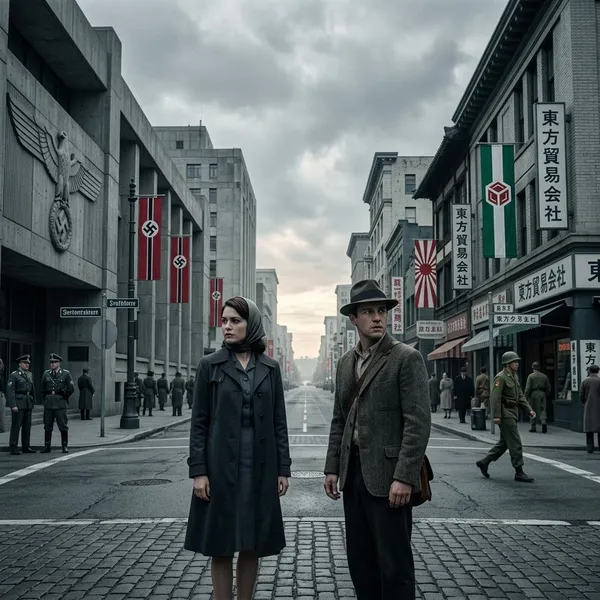
The finale is deliberately half-closed and half-open: John Smith's story ends in collapse, Helen's final choice helps stop his invasion plan, and the portal becomes a mystery the show refuses to pin down. The clearest way to read it is that the Reich's grip is breaking, but the series stops before showing a clean liberation or a fully explained multiverse event.
How The Man in the High Castle ends
The ending moves fast, so the important thing is to separate the plot events from the meaning behind them. On the plot level, Helen betrays John, the Resistance attacks his train, Helen dies, John kills himself, Whitcroft calls off the western invasion, and the portal opens to a crowd of unknown people.
On the meaning level, each event removes one layer of control. John loses control of his wife, then his military plan, then his own future. The American Reich does not disappear, but it stops looking unstoppable. The portal, once treated as a secret imperial weapon, becomes open and unpredictable.
Helen helps the Resistance target the train
Helen's choice is the point where private regret becomes action. She has spent years surviving inside the Nazi system, benefiting from it, fearing it, and trying to tell herself that her silence protects her family. In the finale, she finally stops cooperating.
What makes the decision matter is that she understands the cost. She is not an innocent outsider suddenly discovering what the regime is. She knows John, knows the system, and knows the risk to herself. That makes the betrayal more morally serious than a simple last-minute change of heart.
Helen dies in the crash
Helen dies just after choosing the right side, and that timing is the tragedy. The show does not reward her with a clean escape, because her life has been tied too deeply to the system she finally rejects.
Her death also destroys John's favorite excuse. He has always framed his compromises as protection for his family, but the result is the opposite: Thomas is gone, the marriage is broken, his daughters are in danger, and Helen dies during the plan that was supposed to secure his future.
John Smith takes his own life
John kills himself because he has nowhere left to hide: politically, emotionally, or morally. He is not simply defeated by the Resistance. He is confronted by the fact that he chose this life even after seeing that other versions of himself, and other versions of America, were possible.
Juliana does not execute him, which is important. The show avoids giving him a dramatic martyr's death or an easy revenge scene. His suicide works more like self-judgment: he sees what he became and cannot live with it, but that does not turn him into a redeemed man.
Whitcroft cancels the western invasion
Whitcroft's order may look small next to the train crash and the portal, but politically it is one of the most important moments in the finale. He stops John's planned attack on the West instead of carrying it forward.
The portal opens to an unknown crowd
The final image is meant to stay unresolved. People walk through the portal, but the series does not tell us exactly who they are, where they came from, or what their arrival means for the next day, week, or year.
If you are watching mainly for plot mechanics, that can feel frustrating because the scene raises practical questions and answers very few of them. If you are watching for theme, it works more clearly: the portal has stopped being a Nazi-controlled doorway and has become a symbol of movement, return, and possibility.
What Helen's death means
Helen's death means four things at once: she rejects the Nazi regime, she tries to protect her daughters from John's future, she helps stop a wider invasion, and she acts too late to save herself. That mix is why her ending feels tragic rather than triumphant.
She finally rejects the Nazi regime
Helen's betrayal of John is also a rejection of the world that gave her family status and safety. Earlier, she often shows discomfort or grief, but discomfort is not the same as resistance. In the finale, she makes a choice that has real consequences outside her home.
That distinction matters. A viewer who reads Helen only as a victim may miss the harsher point of her story: she was also protected by the regime for a long time. Her final act matters because she finally stops treating survival as an excuse for silence.
She protects her daughters from John
Helen sees that John's love for his daughters cannot be separated from the world he wants to preserve. If the girls submit, they are shaped by the Reich. If they resist, the Reich may destroy them. Either future is dangerous.
- For Amy, the risk is ideological: she could be absorbed more deeply into Nazi belief.
- For Jennifer, the risk is punishment: her doubts already make her vulnerable.
- For Helen, stopping John becomes the only remaining way to protect them both.
She helps stop the western invasion
Helen is not a military leader, but she is close enough to John to damage his plan. That is the practical power of her betrayal. She passes on information the Resistance could not easily get from the outside.
She acts too late to save herself
Helen's ending is painful because the right choice comes after too much damage has already been done. She helps stop something worse, but she does not get to step into a new life afterward.
That is also why the scene feels more honest than a neat redemption ending would have felt. Late courage can still save other people, but it cannot always save the person who finally finds it.
What happens to America after John Smith dies
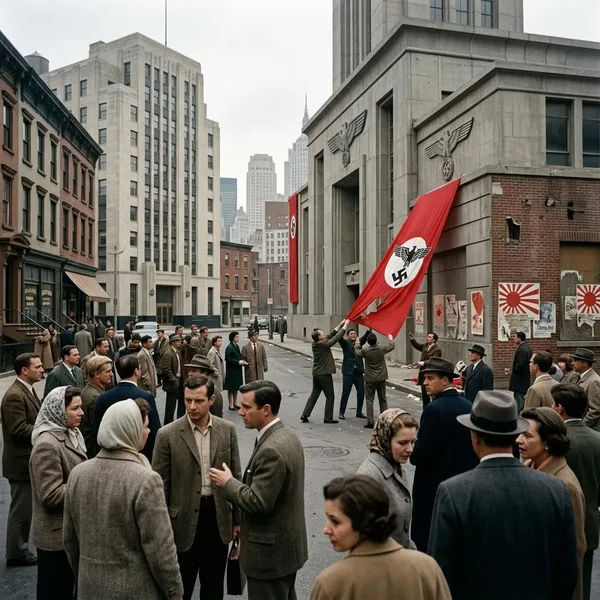
America is not shown as free at the end, but it is clearly no longer stable in the same way. The best reading is that the finale shows the beginning of fragmentation: the West is not invaded, Berlin's grip over North America looks weaker, the former Japanese territory is held by anti-imperial forces, and the Resistance controls the portal.
Whitcroft stops the attack on the West
Whitcroft stopping the invasion is the clearest sign that John's death changes the future immediately. The order prevents another military escalation and shows that John's plan was not automatic without him.
This does not make Whitcroft a liberator. The safer reading is that he is choosing caution, self-preservation, or a different political direction at a moment of crisis. Still, the effect is huge: the Reich's expansion stops at the exact moment its strongest North American figure disappears.
North America begins to pull away from Berlin
The finale suggests, rather than proves, that North America may start separating from Berlin's direct control. John had already built a power base strong enough to imagine a more independent American Reich. After his death, that structure is left without its central figure.
The Black Communist Rebellion holds the former Japanese territory
The former Japanese Pacific States are not simply waiting to be claimed by the Reich. The Black Communist Rebellion has become a real territorial force, which means the western part of the continent has its own political future outside both Japanese and Nazi rule.
This thread is less developed than many viewers wanted, so it is worth being careful with the claim. The finale does not map out how that territory will be governed. What it does show is that anti-imperial resistance is no longer only hiding, fleeing, or surviving in the margins.
The Resistance takes control of the portal
The portal changing hands is both a plot shift and a symbolic one. For the Reich, the machine represented the fantasy of controlling not just territory, but reality itself. Losing it means losing a monopoly on possibility.
A practical way to read the ending is this: the Resistance has not solved the world's problems by taking the portal, but it has stopped the Nazis from being the only people who decide how that power is used. That is why the final scene feels open rather than settled.
What the final portal scene means
The portal scene works best if you allow it to be both literal and symbolic. Literal, because the show has already established travel between realities. Symbolic, because the staging is less interested in logistics than in the image of people crossing into a world where fascist control has just cracked.
A literal crossing between realities
The most straightforward explanation is that the people are physically crossing from another reality into this one. That fits the show's established multiverse rules, even though the finale does not explain the exact mechanics of this particular mass crossing.
The main weakness of the literal reading is detail, not possibility. We know crossing can happen; we do not know why these people arrive at that moment, whether they chose to come, or what they expect to find.
A return of people lost to oppression
The crowd can also be read as a return of lives and histories that fascism tried to erase. That does not have to mean literal resurrection. It can mean the visual return of possibility after a world built on exclusion, murder, and control starts to open.
This reading fits the emotional texture of the series: missing family members, alternate selves, stolen futures, and worlds that might have been. The portal gives those absences a physical shape.
A symbol of freedom and new possibilities
The portal becomes a symbol of freedom because it is no longer fenced off by the people who wanted to own it. The important shift is not that everything is suddenly safe. It is that the future is no longer sealed shut by the Reich.
- For plot-focused viewers, the scene may feel under-explained.
- For theme-focused viewers, the lack of explanation is part of the point.
- For viewers who wanted both, the ending can feel powerful and unsatisfying at the same time.
An intentionally unresolved final image
The ambiguity is deliberate. The finale chooses a haunting image over a tidy answer, which is why the ending still gets debated.
That choice is not automatically a flaw, but it does ask a lot from the audience. The show closes John and Helen's arcs with clear consequences, then leaves the larger world in motion. The result is less "everything is solved" and more "the old order has finally been broken open."
Conclusion
The ending is clearest when you do not force it into one kind of answer. John's death is personal collapse, Helen's death is late moral courage with a tragic cost, Whitcroft's order signals political fracture, and the portal points toward a future the show refuses to define. It is not a neat victory ending, but it is a clear break from the world John tried to preserve.