
Walter White's ending is not a clean redemption story: he returns to Albuquerque to settle unfinished business, protect the last piece of his money, free Jesse, and die in the world he chose. A clear breaking bad ending explained comes down to one split idea: Walt gets control at the end, while Jesse gets the chance to live beyond him.

How Breaking Bad ends
Breaking Bad ends with Walt leaving his New Hampshire hideout and returning to Albuquerque for one final run of carefully arranged moves. He is dying, exposed, and out of time, so the finale focuses on what he can still control rather than what he can repair.
Walt secures money for his children
Walt's money problem is not just how to move it; it is how to make it acceptable. Flynn would reject anything openly connected to him, so Walt forces Gretchen and Elliott Schwartz to create the appearance of a clean gift through a trust.
Walt admits the truth to Skyler
The Skyler scene is the emotional center of the finale because Walt finally drops the lie that everything was only for his family. When he says he did it for himself, because he liked it and was good at it, the show gives the audience the clearest reading of his character.
That honesty matters, but it does not heal the marriage. Skyler does not forgive him, and the scene is stronger because it avoids that shortcut. Walt can give her the coordinates for Hank and Gomez's burial site, which is useful and humane, but the truth arrives after the damage has already become permanent.
Lydia is poisoned with ricin
Lydia dies because Walt hides ricin in the Stevia packet she uses in her tea. It works because he has noticed her routine and turns that habit against her.
She matters to the ending because she is the business link that could keep the blue meth operation alive after Walt is gone. The ricin also pays off a long-running threat from earlier seasons, making her death feel like a closed loop rather than a random final twist.
Jack's gang is destroyed
Jack's compound is the last place where Walt's consequences are still active: Hank's killers are there, his stolen money is tied to them, and Jesse is being held as a prisoner cook. Walt cannot fight them directly, so he builds the kind of solution only he would trust.
- He gets inside: greed and suspicion bring Jack's men into one room.
- He positions the car: the trunk faces the building at the angle he needs.
- He triggers the M60: the remote-controlled gun sweeps through the room before anyone can react.
Jesse escapes and Walt dies
The final movement belongs to both men, but in opposite ways. Jesse gets movement, noise, and escape; Walt gets stillness, completion, and death.
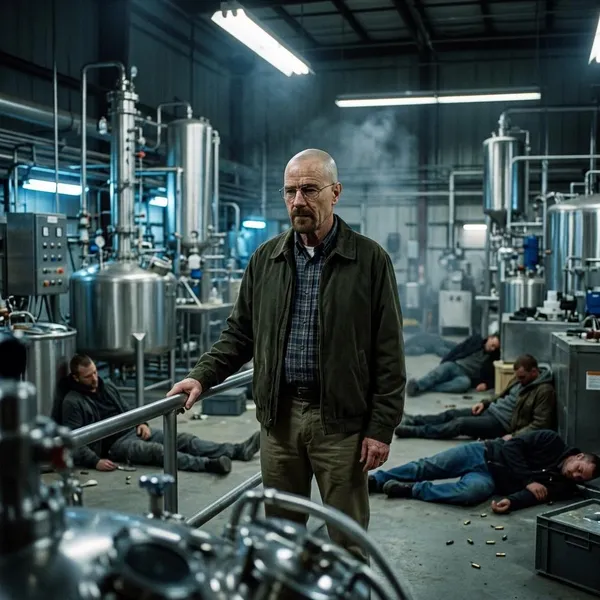
How Walt's final plan works
Walt's final plan works because he stops trying to save his old life. He narrows everything down to a few remaining objectives: move the money, give Skyler something useful, remove Lydia, destroy Jack's gang, and leave Jesse with a real chance to escape.
For a first-time viewer, the plan can look like a sudden return of old genius. On a rewatch, it feels more fatalistic. Walt is effective again because he has almost nothing left to lose, and that makes him more dangerous than he has been in a long time.
Gretchen and Elliott become his middlemen
Gretchen and Elliott are useful because they have the public respectability Walt no longer has. Money coming from them can look like generosity; money coming from Walter White would look like evidence.
The choice also scratches an old wound. Walt's resentment toward Gray Matter has always been part of his pride, so forcing them into his plan lets him solve a practical problem while briefly dominating people connected to the life he believes he was denied.
The ricin removes Lydia
The ricin removes Lydia quietly, which is exactly why Walt uses it. She is careful, anxious, and business-minded, so a direct confrontation would be risky. Her tea routine gives Walt a cleaner route.
The hidden M60 attacks the compound
The hidden M60 is the finale's most exaggerated piece of engineering, but it fits Walt's logic. He is sick, outnumbered, and physically weak, so he turns planning into force.
Walt gives Jesse a way out
Walt gives Jesse a way out when he tackles him before the gun fires and leaves him alive after the compound attack. That does not erase what Walt did to him, and the finale is careful not to pretend it does.
Jesse accepts the opening, not the relationship. He does not forgive Walt, return to him, or play the role Walt assigns. That difference is important: Walt can create the gap in the wall, but Jesse's freedom begins when he chooses not to follow Walt's script.
What Jesse's escape means
Jesse's escape means the return of choice after long captivity. He is not suddenly safe, healed, or innocent, but he is no longer chained to Todd's lab or Walt's emotional control.
This is where the finale shifts from plot closure to emotional release. Viewers who are still asking whether Walt "wins" should look at Jesse's ending first: the most human victory in the finale is not Walt dying on his own terms, but Jesse leaving with a future that has not been fully written for him.
He refuses Walt's final order
Jesse refusing to shoot Walt is not mercy in a soft, sentimental sense. It is a refusal to be used one more time.
Walt slides the gun toward him and silently creates one last role for Jesse to play. Jesse sees it, asks Walt to admit what he wants, and then rejects the whole setup. After years of manipulation through guilt, loyalty, and fear, saying no is the cleanest break he can make.
He kills Todd on his own terms
Todd's death belongs to Jesse. Walt creates the chaos, but Jesse strangles Todd himself with the chain that held him captive.
That detail is not subtle, but it is effective. Todd represents Jesse's immediate imprisonment, Andrea's murder, and the cold politeness of evil without conscience. Killing him is not a strategic chess move; it is Jesse ending the person directly standing between him and freedom.
He leaves captivity behind
Jesse's drive out of the compound is messy because freedom after trauma is messy. His scream is relief, horror, grief, and disbelief all at once.
He regains control of his life
Jesse regains control in the most basic but meaningful sense: his next move is finally his. He chooses not to kill Walt, chooses to kill Todd, and chooses to drive away.
The finale does not promise that he will be fine. It gives him something smaller and more believable: a first moment where survival is no longer dependent on obeying someone else.
Why Walter White dies in the meth lab
Walter White dies in the meth lab because the lab is the most honest final setting for him. His wound makes escape impossible, but the location carries the deeper meaning: this is where his talent, pride, and Heisenberg identity came together most completely.
The lab represents his greatest achievement
For Walt, the lab represents competence without humiliation. His blue meth gave him reputation, status, and proof that he was exceptional.
That is the tragedy inside the image. Walt had real brilliance, but the place where that brilliance becomes most visible is also the place where it becomes most destructive.
The lab reflects his Heisenberg identity
The lab reflects Heisenberg because it is where Walt is least divided. In ordinary life, he feels dismissed or cornered. In the lab, he is precise, admired, feared, and in command.
His final touch on the equipment feels almost affectionate, which is disturbing for exactly that reason. The show lets him admire what he built while making it clear that what he built cost him almost everything else.
His wound makes escape impossible
Walt is hit by a bullet from his own remote-controlled M60, so his final plan succeeds and kills him at the same time.
That detail is one of the cleanest pieces of symbolism in the finale. Walt's intelligence has saved him again and again, but it has also created the machinery of his destruction. In the end, both truths happen in the same room.
His death completes his chosen path
There is no believable ordinary life waiting for Walt after the finale. Hank is dead, his family rejects him, his name is ruined, and his identity has fused too deeply with power.
His death completes the path he chose rather than the life he claimed to be protecting. He gets one last successful plan, one last moment of mastery, and then the story closes on the cost of becoming Heisenberg.
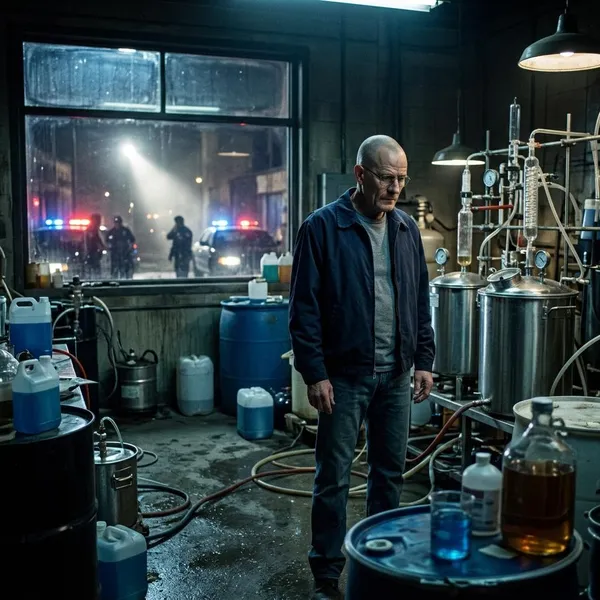
What the Breaking Bad ending means
The ending means control is not the same thing as redemption. Walt can arrange events beautifully in the finale, but he cannot make the past morally balanced.
- Closure: the major plot threads are resolved.
- Justice: Lydia, Todd, and Jack's gang are punished.
- Redemption: Walt does not truly receive this.
That distinction is why the ending can feel satisfying without turning Walt into a hero.
Walt gains control but not redemption
Walt regains control in the finale because he outthinks nearly everyone one last time. Gretchen and Elliott are pressured into helping, Lydia is poisoned, Jack's gang is destroyed, and Jesse is given an opening to escape.
Redemption would require repair, not just efficiency. Hank is still dead. Skyler and the children are still left with the wreckage. Jesse's trauma does not disappear because Walt saves him at the end. The finale gives Walt agency, not forgiveness.
Pride destroys everything he claimed to protect
Pride is the reason Walt's "for my family" excuse falls apart. He did care about providing, but he also wanted recognition, superiority, and the feeling of being untouchable.
By the time he finally gets the money routed toward his children, the family itself has been broken by the choices he made to feel powerful. That is the cruel irony of the ending: Walt can still provide materially, but he has destroyed the home that made providing meaningful.
Honesty arrives after irreversible damage
Walt's confession to Skyler matters because it is finally true. It stops the lie that has protected his ego for most of the series.
Jesse's freedom provides the emotional release
Jesse's freedom is the release the finale needs because it points forward. Walt's ending is complete and sealed, while Jesse's is wounded, uncertain, and alive.
That is also why the final minutes do not feel like simple admiration for Walt's genius. Jesse's escape pulls the emotion away from Walt's cleverness and back toward the human cost of everything that happened.
Conclusion
The finale works because it gives Walt the ending he would design for himself without pretending he deserves peace. He solves problems, admits the truth, destroys enemies, and dies beside the work that made him feel alive; Jesse, meanwhile, drives into an uncertain future that is finally his own. That contrast is the real lasting power of the ending: Walt gets completion, but Jesse gets possibility.