
The quickest fallout season 2 ending explained reading is this: Hank does not lose by dying, he loses by making himself unreachable, while New Vegas becomes the place where every unfinished conflict is about to collide. If you watched mainly for Lucy and Hank, the key is the memory wipe; if you watched for Fallout lore, the real signal is Phase 2 and the factions moving toward war.
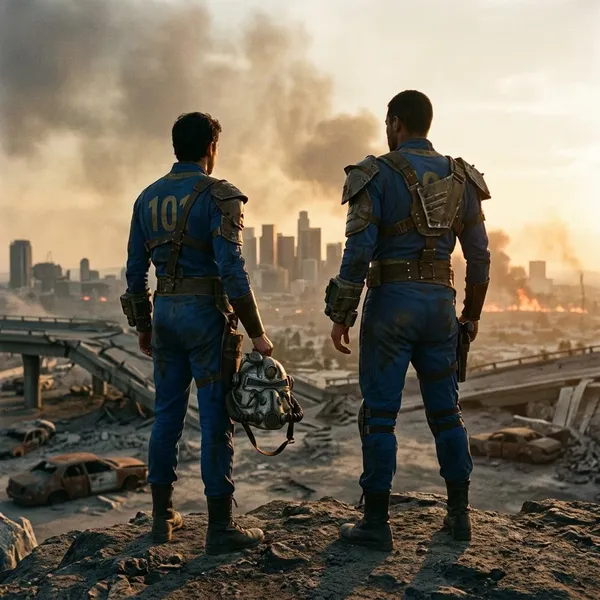
How Fallout Season 2 ends
Fallout Season 2 ends by closing the family confrontation but leaving the political story wide open. Lucy gets Hank cornered, Hank chooses self-erasure over accountability, Maximus survives and returns to Lucy, The Ghoul finds that Barb and Janey's cryo pods are empty, and Steph quietly proves the vault conspiracy is still running.
Lucy implants Hank with the Black Box
Lucy using the Black Box on Hank is not a simple hero moment. It shows that she has finally stopped expecting honesty from him. Earlier Lucy might have tried to appeal to his conscience; finale Lucy understands that Hank's first instinct is always control.
Hank erases his own memories
Hank's memory wipe is the emotional trapdoor of the finale. Instead of confessing, surrendering, or letting Lucy decide what happens next, he destroys the part of himself that can answer for what he did.
The move works on two levels. Personally, it lets him avoid his daughter's judgment. Strategically, it may seal away information about the Enclave, the vault network, Phase 2, or other hidden operators. A dead Hank would be final; a wiped Hank is more disturbing because he is still there, but the truth is not.
Lucy and Maximus reunite
Their reunion is warmer than the rest of the finale, but it is not a reset. Lucy has just lost the last clean version of her father, and Maximus has been pulled deeper into faction politics. When they meet again, they are not two innocent people escaping the wasteland; they are two damaged people standing at the edge of a bigger conflict.
That matters for Season 3 because they may want the same thing, but not always in the same way. Lucy is likely to look for the truth behind the vaults, while Maximus may be forced to think about survival, loyalty, and which faction can actually protect people.
The Ghoul finds the cryo pods empty
The empty cryo pods are a better twist than a simple death reveal. They do not prove Barb and Janey are safe, but they do prove The Ghoul's search is not over. Someone moved them, hid them, rescued them, or used them as part of a larger plan.
The Colorado clue changes his story from grief into pursuit. For viewers following Cooper mainly for the family mystery, this is the scene to hold onto: the finale gives him hope, but it makes that hope dangerous.
Steph activates Phase 2
Steph activating Phase 2 is the clearest sign that Hank was replaceable. The plan does not collapse when he falls. It simply moves to the next stage through someone else with access, confidence, and enough knowledge to act quickly.
Liberty Prime Alpha appears after the credits
The post-credits Liberty Prime Alpha tease is a scale warning. Fallout uses Liberty Prime imagery to signal old-world military power, heavy ideology, and conflicts that are no longer just local survival problems.
Placed after the New Vegas setup, the tease suggests Season 3 may mix faction war with resurrected pre-war weapons. That is a very different kind of threat from Hank in a room with Lucy: less intimate, more destructive, and harder for any one character to control.
Why Hank wipes his own mind
Hank wipes his own mind because it is the last piece of control available to him. He cannot beat Lucy emotionally, he cannot safely explain the whole truth, and he cannot let himself become a source of information for anyone else.
He avoids Lucy's judgment
Lucy's judgment is the one punishment Hank cannot easily dismiss. Enemies can be labeled as threats. Strangers can be managed. Lucy is different because she once believed in the version of him he wanted to be.
That is why the memory wipe hurts more than a normal escape. Hank does not just avoid consequences; he avoids the moment where Lucy gets to look at him, name what he did, and demand an answer from the man who raised her.
He protects the Enclave plan
The finale strongly points to a wider Enclave-linked operation, but it does not spell out every detail. That is where Hank's wipe becomes practical: if his mind contains locations, names, protocols, or future instructions, then his memories are dangerous once he is captured.
Steph's Phase 2 activation supports that reading. Hank may have mattered, but the system was not built to depend on one man. His self-erasure helps keep the larger machinery hidden for a little longer.
He controls his final choice
What makes the wipe feel true to Hank is that it is still an act of authorship. He cannot control Lucy anymore, he cannot control the room, and he cannot control what people think of him. So he controls the last remaining thing: whether anyone gets the full Hank after this moment.
He denies Lucy the truth
The cruelest part is not that Hank survives. It is that Lucy loses the chance to ask the questions that matter most while he is still capable of answering them. Her family, the vaults, the Enclave connection, the purpose of the experiments — all of it becomes harder to reach because Hank chooses silence in the most permanent way he can.
Why war is coming to New Vegas
War is coming to New Vegas because the finale places the city at the crossing point of almost every major interest: the NCR, the Legion, Lucy and Maximus, the vault conspiracy, and the leftover power of the old world. New Vegas is not just a backdrop anymore. It is the prize.
If you are watching casually, the practical read is that New Vegas is where the next season's personal stories will be forced into public conflict. If you are watching for Fallout faction politics, the finale is more specific: organized powers are moving back onto the board, and none of them can afford to ignore the city.
The NCR saves Maximus
The NCR saving Maximus shows that it still has reach. This is not just a lucky rescue by a few scattered survivors; the scene suggests coordination, interest, and enough force to change an outcome at the right moment.
It also gives Maximus a new problem. Being saved by a faction rarely comes free in Fallout. Even if the NCR looks like the better option in the moment, Maximus may now be useful to people with their own plans for New Vegas.
Lacerta takes control of the Legion
Lacerta taking control of the Legion matters because a faction built on hierarchy needs visible strength from its leader. A new ruler does not secure loyalty by waiting quietly. New Vegas offers the kind of target that can prove command in one dramatic move.
That makes Lacerta dangerous even before a full battle begins. He needs momentum, the Legion needs purpose, and the city gives both of them a stage.
The Legion marches toward New Vegas
The Legion's movement toward New Vegas fits the faction's logic. Conquest is not just a tactic for them; it is how they prove their worldview. Taking the city would mean territory, fear, and symbolic victory all at once.
The city also looks vulnerable enough to tempt them. When multiple factions sense a power vacuum, the most aggressive group often moves first. That is the warning the finale leaves behind.
Lucy and Maximus face a faction war
Lucy and Maximus are not heading into a simple adventure with a few enemies on the road. They are walking into a faction war where every alliance may cost something. Lucy will be tempted to expose and stop hidden systems; Maximus may be pushed toward whichever power seems capable of keeping people alive.
That difference could make them stronger, but it could also split them under pressure. A low-risk choice, like trusting one helpful group for one rescue, is very different from a long-term choice, like backing a faction that wants New Vegas for itself.
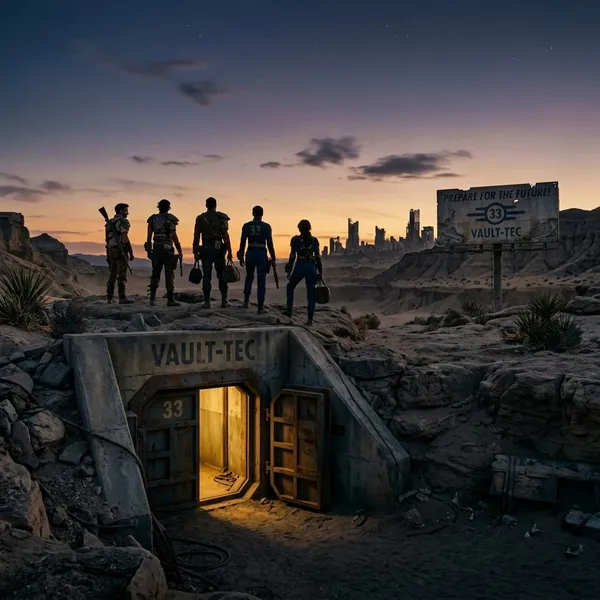
What Phase 2 means
Phase 2 appears to be the next stage of the hidden vault program, likely connected to the Enclave or an Enclave-style command structure. The finale does not define the full plan, so the safest reading is about direction rather than exact mechanics: observation is giving way to action.
- Phase 1 likely involved control. Vault populations, social design, secrecy, and long-term observation.
- Phase 2 likely involves use. Activating people, data, technology, or plans shaped by those controlled conditions.
- The surface may be the target. New Vegas and the surrounding factions could become part of the experiment rather than separate from it.
Steph contacts the Enclave
Steph's final communication strongly suggests she is contacting the Enclave or a related hidden authority. The key detail is her calmness. She does not act like someone guessing in a crisis; she acts like someone following a known channel.
That turns Steph into more than a vault survivor with secrets. She becomes a bridge between domestic vault drama and the larger old-world project still operating in the background.
The vault plan enters its next stage
"Phase 2" matters because phased language implies a roadmap. This does not sound like Steph improvising after Hank fails. It sounds like a planned transition that was waiting for the right trigger.
What the stage involves is still open: hidden agents, population control, surface manipulation, preserved technology, or some mix of all four. The important point is that the vault plan is moving forward, not collapsing.
Hank's agents remain active
Hank's fall does not remove the threat because the finale shows at least one active operator still in place. Steph may be the visible example, but a plan this durable probably does not rely on a single backup.
That is the bigger danger for Lucy. She is not just hunting one villain's leftover secrets. She may be dealing with a network designed to survive exposure, replace compromised people, and keep working while everyone argues over the obvious enemy.
The surface stays the real experiment
The strongest Phase 2 reading is that the vaults were never the final point. They were controlled environments used to shape people, gather results, and preserve certain plans. The surface is where those results become useful.
That makes New Vegas especially important. A city under pressure from the NCR, the Legion, and old-world technology is the perfect place to test whether the vault project can influence what rises from the wasteland. For someone watching only the family story, Phase 2 may feel like background lore; for the next season's conflict, it may be the hidden hand behind the whole board.
Conclusion
The ending works because it refuses to give anyone a clean win. Hank survives by making himself unreachable, Lucy gets strength without closure, The Ghoul gains hope without proof, and New Vegas becomes the place where private wounds meet public war. The practical takeaway is that Season 2 is not ending one mystery so much as showing which questions now matter most: who controls the vault plan, what Phase 2 is meant to activate, and who will reach New Vegas before the city breaks.