
The lazarus ending explained answer is fairly simple on the plot level: Sam Olsen killed Sutton, Jonathan Lazarus dies after Alison closes in on his crimes, and Aidan's final appearance suggests the family's violence has not ended. The harder part is emotional, because Joel gets answers without getting release, and the show keeps his visions suspended between ghost story and trauma response.

How Lazarus ends
Lazarus ends by solving the main murder mystery while refusing to make the ending feel safe. The finale gives viewers three practical anchors to read the last episode: Alison exposes the truth around Jonathan, Sam Olsen is identified as Sutton's killer, and Aidan's final scene turns the story from a solved case into a warning about inherited damage.
Alison Brown is exposed
The heading is a little misleading if read literally: Alison is not exposed as a villain. Her investigation exposes the version of events Jonathan has been hiding behind. She connects the old inconsistencies, challenges his respectable image, and becomes the person who turns suspicion into a direct threat.
Her role matters because Joel is too tangled in grief, memory, and fear to build the case cleanly on his own. Alison gives the finale its outside pressure. Without her, the truth might stay trapped inside Joel's visions and half-memories.
Jonathan's crimes are revealed
Jonathan Lazarus is revealed as a man who used trust as cover. The therapy tapes, the concealed history, and the manipulation around the old cases show that he was not simply a flawed father with secrets. He built a life around controlling what other people knew.
- Professionally, he violated the privacy of people who trusted him.
- Personally, he shaped his family through silence and fear.
- Narratively, he becomes the source of damage that keeps echoing after his death.
Sam Olsen is named as Sutton's killer
Sam Olsen killed Sutton. That is one of the finale's clearest answers, and it closes the question that has haunted Joel for years.
The important catch is that factual closure does not give Joel emotional closure. Sutton's death shaped his childhood, his identity, and his obsession with the past. Naming the killer answers the case, but it cannot give Joel back the life he lost.
Joel confronts his father's legacy
Joel's real confrontation is not only with Sam or with Jonathan's crimes. It is with the possibility that his whole life has been built inside his father's lies. The tapes, the visions, and Alison's discoveries all push him toward the same frightening point: the past was never finished with him.
Aidan appears with a bloody knife
The last shock comes when Joel reaches Laura's house, finds signs of violence, and sees Aidan holding a bloody knife. Aidan says, "I'm sorry," which strongly suggests he has attacked Laura, possibly killed her, though the episode leaves a sliver of uncertainty.
For a viewer treating the finale like a crime puzzle, this scene is a cliffhanger. For a viewer reading it thematically, it is the point of the ending: Jonathan may be gone, but the violence he helped create has moved into the next generation.
Why Jonathan Lazarus killed himself
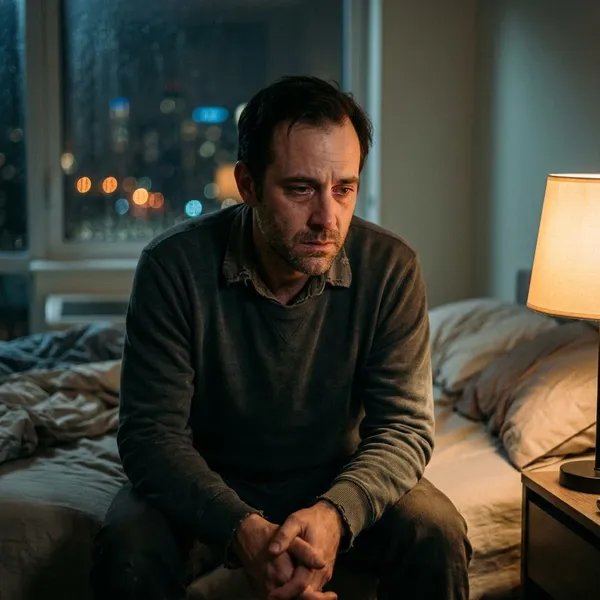
Jonathan kills himself because Alison has cornered him. His secrets are no longer safely scattered across old memories, private recordings, and buried suspicions. Once those pieces start forming a public truth, he chooses death rather than exposure.
Alison uncovered his lies
Alison's discovery is dangerous to Jonathan because it turns isolated clues into a pattern. He could survive doubt, rumor, and confusion. He cannot survive a coherent account of what he did and how long he hid it.
She threatened to expose him
Exposure is what Jonathan fears most. Legal punishment would matter, but the deeper blow is the collapse of his identity: respected doctor, controlled father, intelligent authority figure. Alison threatens the image that allowed him to keep power over everyone else.
That is why the timing of his suicide matters. He does not die because the past suddenly becomes unbearable to him. He dies when other people are about to see it clearly.
Suicide offered him an escape
Suicide lets Jonathan avoid confession, questioning, shame, and direct accountability. It also leaves the people he harmed with the worst kind of aftermath: enough evidence to know he was guilty, but not enough living access to force him to answer.
- For Joel, it removes the chance to confront his father fully.
- For Alison, it complicates the path to a complete public reckoning.
- For the victims, it leaves justice feeling unfinished.
His death protected the secret temporarily
Jonathan's death slows the truth down, but it does not erase it. The tapes still exist, Alison has already connected key details, and Jenna's discovery creates more questions about what Joel heard or remembered.
That temporary delay is still damaging. People often hesitate around the reputation of the dead, especially when grief and scandal collide. Jonathan uses that pause to keep shaping the story even after he is gone.
Were Joel's ghost visions real
The finale keeps Joel's visions deliberately unresolved. They may be actual ghostly messages, or they may be trauma, memory, and recorded voices returning in a form Joel can finally notice. The safest reading is not to choose too quickly.
If you watch Lazarus as a supernatural mystery, the visions look like the dead pushing Joel toward justice. If you watch it as a psychological thriller, they look like buried knowledge breaking through under pressure. The finale is built to support both experiences.
The visions lead Joel toward real clues
Whatever causes them, Joel's visions are not random scares. They point him toward real details, hidden connections, and emotional truths that the official family story has suppressed. That is why they matter even if they are not literal ghosts.
The therapy tapes contain the same voices
The therapy tapes make the grounded explanation much stronger. Jenna finds recordings that contain voices and phrases connected to what Joel seems to experience, which suggests he may be hearing material stored somewhere in memory rather than receiving messages from the dead.
Still, the tapes do not completely flatten the mystery. The show gives a rational route into the visions, but it keeps the eerie feeling alive.
Trauma may shape what Joel sees
Trauma is the most practical non-supernatural explanation. Joel has lived with grief, family secrecy, and distorted memory for years, so it makes sense that old fragments would return as images, voices, and shocks rather than as clean recollections.
This reading makes the visions feel less like a trick and more like the show's main metaphor. The past behaves like a ghost because no one dealt with it honestly when it was still possible to limit the damage.
The finale keeps both readings possible
The finale refuses to close the door on either answer. The tapes support memory and trauma; the atmosphere still supports haunting. That balance is intentional, because the emotional result is the same in both versions: the dead and the damaged still direct the living.
What the therapy tapes reveal
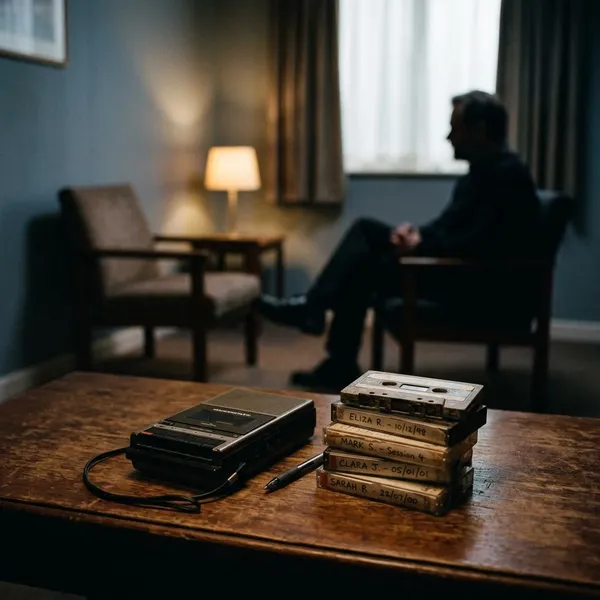
The therapy tapes are the finale's most important piece of physical evidence. They reveal that Jonathan secretly recorded people who trusted him, and they show how private pain became part of his hidden archive.
They also change how viewers should judge Joel's visions. Once the same voices appear on tape, the question shifts from "Is Joel imagining everything?" to "What did Joel absorb before he could understand it?"
Jonathan secretly recorded his sessions
Jonathan's secret recordings show his need for control. Therapy is supposed to be a protected space, but he turns it into surveillance. That violation tells us more about him than any single confession could.
The tapes also give the story something firmer than rumor. They make the hidden abuse of trust tangible.
The recordings expose his victims
The recordings expose the people Jonathan harmed in the most uncomfortable way: through their own voices. They are evidence, but they are also reminders that the mystery is not just a puzzle. Vulnerable people were used, stored, and silenced.
Alison's confrontation reveals the cover-up
Alison's confrontation shows that the tapes are part of a wider cover-up, not a separate ethical lapse. Jonathan's power came from controlling what was recorded, what was hidden, and what could be denied.
That is the point where the story becomes larger than one dead child or one family secret. It becomes a portrait of how authority can protect itself while harming the people who most need protection.
Jenna's discovery questions Joel's memories
Jenna's discovery makes Joel's memories less certain but more interesting. If Joel heard those voices before, even indirectly, then his visions may be distorted recollections rather than supernatural messages.
That does not make Joel "wrong." It means his mind may have carried pieces of the truth long before he had the language or safety to understand them.
What the Lazarus ending really means
The real meaning of the ending is that solving a crime does not automatically stop its consequences. Lazarus gives viewers answers, then shows why answers are not enough when a family has been shaped by secrecy for years.
Solving a murder cannot heal every wound
Sutton's killer is named, but Joel is not healed by that knowledge. The loss has already shaped his childhood, his relationships, and the way he understands himself. The finale treats closure as useful but limited.
This is the difference between a neat mystery ending and the ending Lazarus actually gives. The case can be solved on paper while the people inside it remain broken.
Hidden violence destroys entire families
The violence in Lazarus does not stay attached to one event. It spreads through silence, parenting, memory, and fear until even people who did not commit the original crimes live inside their consequences.
- Sutton's death defines Joel's grief.
- Jonathan's secrecy poisons trust across the family.
- Aidan's final scene suggests the damage has found a new outlet.
Trauma passes between generations
The ending's darkest idea is that trauma can move from one generation to the next without anyone naming it clearly. Jonathan damages Joel through lies and control; Joel's unresolved pain appears to echo around Aidan. The cycle is not identical, but it is recognizable.
For someone watching mainly for the thriller plot, Aidan's scene is a shock ending. For someone watching the family story, it is the moment the theme becomes unavoidable.
Joel may repeat the cycle he fears
Joel may not become Jonathan in a direct, one-to-one way. The fear is subtler than that. He may carry forward the same silence, panic, and emotional damage even while trying to escape his father's shadow.
That is what makes the ending tragic rather than simply dark. Joel finally understands the pattern, but understanding it may not be enough to protect Laura, Aidan, or himself.
Conclusion
Lazarus ends with the main mystery answered and the deeper wound still open: Sam Olsen killed Sutton, Jonathan chose death to avoid exposure, Joel's visions remain caught between haunting and trauma, and Aidan's bloody final scene suggests the family cycle is still active. The practical way to read the ending is not as a clean twist, but as a warning that truth can arrive after the damage has already learned how to survive.