
Loki ends Season 2 by destroying the Temporal Loom, saving the branching timelines, and taking the lonely place at the center of the multiverse. The key point is that he does not fix He Who Remains' system; he rejects it. His final throne is not a victory lap, but the cost of letting everyone else keep free will.
What happens at the end of Loki Season 2?
The finale is easier to follow if you separate three things: the Loom is a trap, Sylvie is the moral test, and Loki's throne is the replacement for the machine. Loki spends the episode trying to repair the problem, only to learn that the "solution" everyone is chasing was never meant to save every timeline.
Loki masters his time-slipping
The finale stops treating Loki's time-slipping as a glitch and turns it into the skill that lets him understand the whole crisis. He jumps back again and again to the Loom disaster, testing fixes, learning from failure, and eventually spending centuries studying the TVA's systems with O.B.
That matters because his final choice is not impulsive. Loki has already tried the practical fix, the technical fix, and the "try harder" fix. When he finally walks away from the Loom, it is because he knows the machine cannot give him the future he wants for his friends.
He Who Remains reveals the Loom's true purpose
He Who Remains does not reveal a broken machine; he reveals a rigged system. The Temporal Loom was designed as a failsafe for the Sacred Timeline. If branching became too much, the Loom would protect the controlled timeline and let the other branches die.
- Repairing the Loom means restoring a system built around limitation.
- Killing Sylvie means saving He Who Remains and returning to his version of order.
- Destroying the Loom means accepting danger so the branches can live.
Loki refuses to kill Sylvie
Sylvie is the choice that exposes Loki's growth. Killing her would be the neatest way to protect the old structure, but it would also prove that Loki learned nothing from the TVA's cruelty.
Her life represents the thing the Sacred Timeline always denied: the right to choose a path that was not approved in advance. Loki refusing to kill her is not only about affection. It is his refusal to build peace on someone else's erased agency.
He destroys the Loom and saves the branches
Destroying the Loom looks reckless for a second, but it is the only way out of He Who Remains' bargain. Loki is not abandoning the timelines. He is removing the machine that could only preserve them by controlling them.
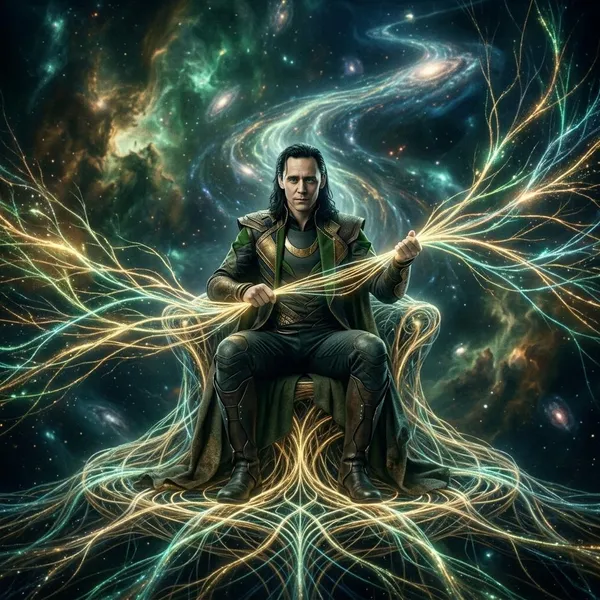
Once the branches begin to fade, Loki gathers them himself and gives them a new shape. The scene works because it changes the multiverse from a diagram into something fragile and alive. He is no longer trying to make reality obey a system; he is keeping countless possible lives from going dark.
He takes his throne at the end of time
The throne is the final twist of Loki's old dream. He wanted to rule because he thought power would prove his worth. At the end of Season 2, he gets a throne only after giving up control, companionship, and ordinary life.
He does occupy a position similar to He Who Remains in one sense: he sits at the center of time. The difference is moral. He Who Remains used that position to prune possibility. Loki uses it to sustain possibility, even though it leaves him alone.
What does Yggdrasil mean in the Loki ending?
Yggdrasil gives the ending its mythic shape. After Loki gathers the branching timelines, they form a vast glowing tree that echoes the Norse World Tree. That image is doing a lot of work: it tells you the multiverse is no longer being forced through a machine, but held as a living, branching structure.
The timeline tree echoes the Norse World Tree
The final image clearly points toward Yggdrasil, the World Tree from Norse mythology. Marvel does not pause the episode for a mythology lesson, but the visual is plain: branches stretching outward, worlds connected, and Loki sitting at the center as the one who keeps the structure alive.
That choice fits him better than a purely sci-fi ending would. Loki has always been half political character, half mythic figure. The tree lets the finale move him out of TVA machinery and back into legend.
Its branches represent a living multiverse
The branches are not abstract "timeline problems." They stand for people, histories, relationships, and futures that the old TVA would have treated as disposable.
Its shape connects Loki to his heritage
The Yggdrasil shape reconnects Loki to the Asgardian and Norse imagery that has always surrounded him, but it does not simply make him a king in the old sense. The horns, the throne, the magic, and the tree all turn him into something more ancient and stranger than a TVA agent with better powers.
It also transforms traits that once made him destructive. His ambition becomes endurance. His cleverness becomes patience. His love of grand gestures becomes a final act that actually protects people.
Its throne turns glory into sacrifice
The throne is still grand, but it is not glamorous. Nobody cheers. Nobody kneels. Loki cannot enjoy the life he saved.
That is why the ending lands so hard. "Glorious purpose" used to sound like ego. By the final shot, glory means staying in place forever so other people can move freely.
What happens to the TVA and Loki's friends?
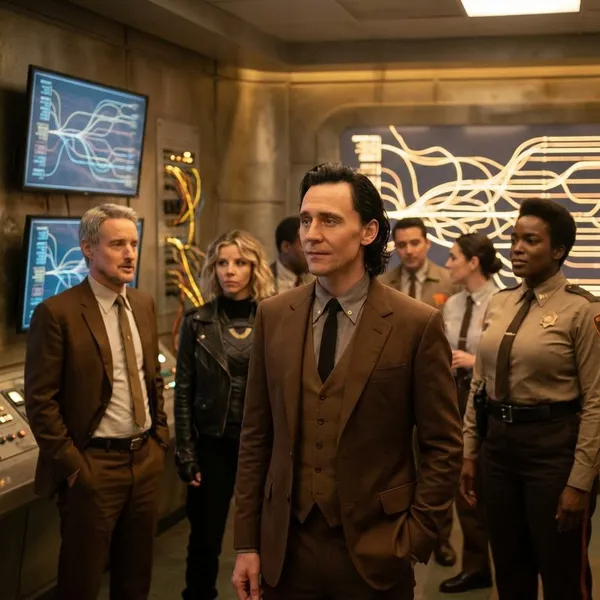
The TVA survives, but its purpose changes. It no longer treats every branch as something that must be pruned. Its new job is closer to protection and threat monitoring, especially where Kang variants could become dangerous.
The smaller endings for Loki's friends are just as important as the cosmic image. If you watched mainly for Mobius and Sylvie, the finale is not saying they get a perfect happy ending. It says they get the thing Loki bought for them: the chance to decide what to do next.
The TVA begins protecting branched timelines
The new TVA is no longer built around automatic erasure. Its focus shifts toward allowing branches to exist while watching for specific threats that could harm the multiverse.
That distinction matters. A branch is no longer treated as guilty just for existing. The danger now comes from what someone on a branch may do, not from the branch's existence itself.
Mobius visits the life taken from him
Mobius does not rush back into his old life. He watches it from a distance, seeing the family and identity the TVA took from him.
That restraint makes his ending more painful than a simple reunion would have been. Mobius has gained the truth, but not an easy way to become the man he used to be. For someone who spent so long avoiding his own past, standing still and looking at it is already a huge step.
Sylvie returns to the life she chose
Sylvie's ending is deliberately ordinary. After a life shaped by running, hiding, and being hunted, choosing a quiet life on a branch is not small. It is the freedom she was denied as a child.
The finale also avoids turning her into Loki's reward. She matters deeply to his choice, but she still gets to remain her own person, with her own future and her own uncertainty.
B-15 and O B rebuild the TVA
B-15 and O.B. give the new TVA a believable foundation. B-15 understands the moral damage the old TVA caused, while O.B. understands the machinery and systems that keep the place running.
- B-15 brings leadership shaped by conscience, not blind loyalty.
- O.B. brings the technical knowledge needed to make the new mission work.
- The TVA staff now have to prove the institution can protect without becoming what it was.
Ravonna faces an unknown threat in the Void
Ravonna's final scene leaves her in the Void, facing something the episode does not fully show. The safest reading is that she is in serious danger, with Alioth being the obvious possibility because of the setting and the purple glow.
Her ending keeps one thread unresolved without stealing closure from Loki's sacrifice. The multiverse has a new chance, not a guarantee that every threat has disappeared.
What does the Loki Season 2 ending mean?
The ending means Loki finally becomes the opposite of the person he once tried to be. He does not win by taking control. He wins by accepting the burden that lets other people live without his control.
For MCU continuity watchers, the finale also changes the role of the TVA. Kang variants remain a concern, but He Who Remains is no longer presented as the only answer to them. The story leaves room for future danger while still making Loki's choice feel complete.
Loki earns a throne by giving up control
Loki's throne only means something because he no longer wants it for the old reasons. Earlier versions of Loki wanted admiration, obedience, and proof that he mattered. This Loki accepts a throne that gives him none of those comforts.
That reversal is the character arc in one image: the symbol of domination becomes a seat of service.
He saves his friends by leaving them
Loki's sacrifice hurts because it is personal before it is cosmic. Mobius, Sylvie, B-15, and O.B. are the people who taught him to care about something beyond himself. Saving them means removing himself from the life he finally wanted to share.
That is the finale's sharpest trade-off. He does not lose his friends because he fails. He loses them because his success requires him to stand outside their lives.
Free will survives through his sacrifice
The show does not pretend free will is tidy. Branching timelines can create conflict, and Kang variants may still become a threat. Loki's answer is not that freedom is safe; it is that fear does not justify total control.
If He Who Remains represents peace through pruning, Loki represents risk with conscience. That is why his choice feels more humane, even though it is less secure.
His glorious purpose becomes a lifelong burden
Loki finally gets a purpose as large as he always imagined, but it is nothing like the fantasy he once chased. It is quiet, lonely, and possibly endless.
Comic readers may connect this to the "God of Stories" idea, and the comparison makes sense. The series itself does not stamp that title on him, but it leaves him in a role where he protects branching possibilities rather than ruling one fixed reality.
Conclusion
Loki's ending works because it gives him the throne he used to want and makes it mean the opposite. He destroys the Loom, preserves the branches, and becomes the lonely guardian of a living multiverse. The practical reading is simple: he does not defeat control by becoming a better tyrant; he defeats it by carrying the cost of freedom himself.