
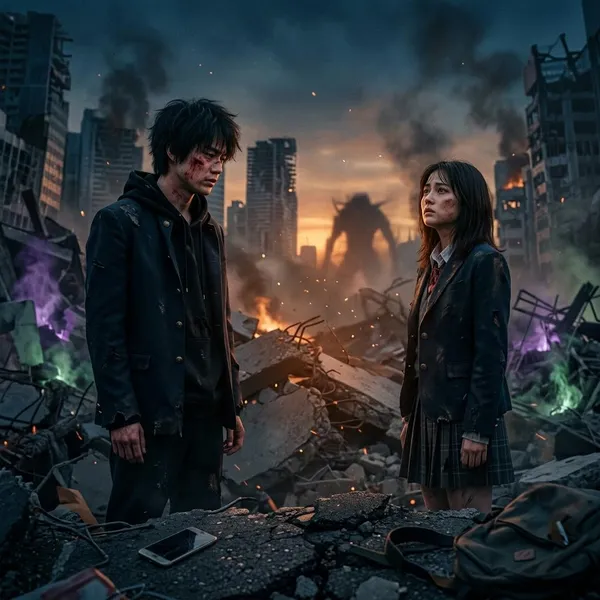
The jjk season 2 ending explained answer is this: Kenjaku wins Shibuya, Mahito is removed as an independent villain, Gojo stays sealed, and Yuji is pushed back into execution territory. The finale is not meant to feel like closure; it is the moment the story stops being about surviving one disaster and starts being about living inside the world that disaster created.
How JJK Season 2 ends
Season 2 ends with the Shibuya Incident technically over, but the villains get the bigger win. The heroes survive pieces of the night, not the system around them. If you are anime-only, the most important thing to track is not every fight detail but the chain reaction: Mahito falls, Kenjaku uses him, Gojo remains unavailable, and Yuji loses the protection that kept his execution delayed.
Kenjaku absorbs Mahito
Mahito is finished as an independent villain once Kenjaku absorbs him through Cursed Spirit Manipulation. The scene is deliberately humiliating for Mahito: after causing so much fear, he ends up running, cornered, and treated as a resource.
This is also where Kenjaku fully overtakes him as the real long-term threat. Mahito hurt Yuji in a personal, emotional way. Kenjaku is colder and broader; he lets Mahito grow because Mahito's technique becomes useful for a plan far bigger than Shibuya.
Idle Transfiguration awakens new players
With Mahito absorbed, Kenjaku can use Idle Transfiguration at a much larger scale. Instead of reshaping one victim in a fight, he activates people he had already prepared across Japan.
Gojo remains sealed
Gojo is still sealed in the Prison Realm at the end of Season 2. That single fact makes every other problem worse, because no one left can simply step in and force the situation back under control.
Do not read his sealing as a temporary inconvenience. In practical story terms, Gojo is removed from the board while Kenjaku starts the next phase. The heroes may want him back, but wanting him back is not the same as having a way to reach him immediately.
Cursed spirits spread across Tokyo
Tokyo does not return to normal after the main fights stop. The fear, death, and confusion left by Shibuya create the kind of environment where curses and public disorder can keep spreading.
Yuta returns to execute Yuji
Yuta Okkotsu's return is one of the finale's sharpest cliffhangers because he comes back with an official order to execute Yuji. If you watched Jujutsu Kaisen 0, the shock is stronger: Yuta is not introduced as a random enemy, but as someone viewers already know can be thoughtful, loyal, and extremely dangerous.
The important question is not only "Can Yuta kill Yuji?" It is also "What does Yuta really intend?" The order is real, the threat is real, but Yuta's role is more complicated than a simple villain reveal.
How Kenjaku sets up the Culling Game
Kenjaku sets up the Culling Game by turning prepared people into active participants. Season 2 does not explain every rule yet, so anime-only viewers do not need to solve the whole game from the finale alone. What you do need to understand is the setup: Kenjaku creates players, spreads them across Japan, and designs a conflict where survival forces cursed energy to evolve.
He activates people with dormant techniques
Some people already had the potential for cursed techniques but could not properly use them. Kenjaku alters them so that hidden ability becomes active.
That creates a dangerous middle ground. These are not necessarily trained sorcerers, and they are not automatically villains. Some may be confused people suddenly thrown into a supernatural crisis. Others may adapt quickly or become threats because fear, power, and survival pressure are a bad mix.
He awakens vessels carrying cursed objects
Kenjaku also awakens vessels connected to cursed objects. This brings older powers and past sorcerers into the present through human hosts.
The difference between these vessels and newly awakened modern people is experience. A modern person may panic after gaining a technique. An older sorcerer returning through a vessel may already understand combat, strategy, and killing. That makes the Culling Game setup more dangerous than a simple increase in enemy numbers.
He releases new sorcerers across Japan
The crisis is not limited to one school, one curse user group, or one sealed-off district. Kenjaku spreads new players across Japan, which makes a clean response almost impossible.
- For civilians: the line between normal life and cursed conflict becomes harder to see.
- For surviving sorcerers: the problem becomes too large to contain with normal missions.
- For Kenjaku: the wide spread buys time, confusion, and pressure.
He turns the country into a testing ground
Kenjaku's goal is not random destruction. He treats Japan like an experiment in forced evolution, cursed energy, and survival under extreme pressure.
Why Gojo's sealing changes everything
Gojo's sealing is the biggest structural change in the ending. If he were free, Kenjaku would have to move more carefully, the higher-ups would be less bold, and Yuji would have a stronger shield against execution. With Gojo gone, every weak part of jujutsu society becomes exposed at once.
For anime-only viewers, the common mistake is treating Gojo's absence as just "the strongest fighter is missing." It is bigger than that. He was also a deterrent, a political obstacle, and a safety net for students who did not fit the system's rules.
The strongest sorcerer is removed
Gojo is not dead, but he is removed from the active battlefield. In the short term, that creates almost the same practical problem: he cannot rescue students, stop Kenjaku, or intimidate the authorities into backing down.
Jujutsu society loses its balance
Jujutsu society was already unstable before Shibuya. Gojo challenged the old leadership, but he had not replaced the system underneath it. Once he is sealed, the conservative side has more room to act.
Yuji becomes the clearest example. Sukuna's destruction gives the higher-ups a reason to push execution again, even though Yuji himself did not choose what Sukuna did. The institution responds to fear by becoming harsher, not wiser.
Kenjaku can move without Gojo stopping him
Kenjaku does not need to beat Gojo in a straight fight if he can remove him at the right time. That is the whole point of the Prison Realm strategy.
After Shibuya, Kenjaku moves quickly because the timing is perfect: the heroes are exhausted, the city is damaged, the system is confused, and Gojo cannot interfere. The finale makes clear that sealing Gojo was not the final prize. It was the door Kenjaku needed opened.
Yuji becomes vulnerable to execution again
Yuji's delayed execution returns as an immediate threat because Gojo is no longer there to protect him. Earlier, Gojo could argue for keeping Yuji alive and had enough power to make that argument matter.
After Shibuya, Yuji is in the worst possible position: Sukuna caused mass destruction using his body, the leadership wants someone to blame, and Yuta is strong enough to make the order feel serious. If you are trying to judge Yuji's situation, start there. His danger is no longer only from curses; it now comes from the society he was fighting for.
Where the main characters end up
The main cast does not end Season 2 with clean resolutions. They end in different kinds of uncertainty: Yuji is alive but targeted, Megumi survives into a worse world, Nobara's status is left unresolved, Gojo stays trapped, and Yuta returns under an execution order.
Yuji survives with guilt and a death sentence
Yuji survives, but he is emotionally wrecked. He carries guilt for Sukuna's destruction and for the people lost around him, even when the blame is not simple or fair.
His death sentence returning makes that guilt harder to process. There is no quiet recovery period. Yuji leaves Shibuya grieving, exhausted, and hunted by the same jujutsu world he has been trying to help.
Megumi survives the Shibuya Incident
Megumi survives, and his survival matters because he remains one of the few steady perspectives around Yuji. His ending is quieter than Yuji's, but it is not comfortable. He is alive in a world with fewer protections, more political instability, and much less room for student-level mistakes.
Nobara's fate remains unconfirmed
Nobara's fate is not confirmed by the end of Season 2. The anime leaves viewers in uncertainty rather than giving a clean death confirmation or a reassuring recovery scene.
That uncertainty is part of the emotional damage of Shibuya. A confirmed answer would give viewers a place to land. Instead, Nobara's condition stays suspended, which keeps hope and dread active at the same time.
Gojo stays trapped in the Prison Realm
Gojo remains trapped in the Prison Realm. There is no hidden rescue at the end of the season and no quick reversal that softens the consequences of Shibuya.
His continued absence also changes the younger characters' role. They cannot wait for the strongest adult to fix the battlefield. Whether they are ready or not, they have to operate in the gap Gojo leaves behind.
Yuta returns as Yuji's appointed executioner
Yuta returns officially as Yuji's appointed executioner. That wording matters because the order comes from the authorities, not from a personal grudge shown in the finale.
What the JJK Season 2 ending really means
The ending means the story has crossed a point of no return. Shibuya does not just injure the heroes; it destroys the old balance that made earlier arcs feel contained. The school structure, Gojo's protection, and the idea of hidden incidents being cleaned up afterward all become much weaker.
The next phase is darker because the question changes. It is no longer only "Can the heroes stop this enemy?" It becomes "Can they survive the new world Kenjaku has created?"
Kenjaku replaces Mahito as the main threat
Kenjaku replaces Mahito because the threat shifts from personal cruelty to planned collapse. Mahito was terrifying in direct encounters, especially for Yuji. Kenjaku is dangerous because he thinks in systems, years, and entire populations.
This does not make Mahito unimportant. His role was to break people and develop the technique Kenjaku needed. But after the finale, the story's main pressure comes from Kenjaku's design, not Mahito's impulses.
Shibuya destroys the old balance of power
Before Shibuya, the jujutsu world was flawed but still recognizable: schools trained sorcerers, Gojo deterred major threats, and most civilians remained outside the truth. After Shibuya, that arrangement no longer works.
The old balance depended too much on Gojo and too little on a healthy system. Once he is sealed and Kenjaku activates his plan, everyone has to deal with the cost of that weakness.
Yuji loses the protection around him
Yuji loses protection on several levels at once. Gojo cannot defend him, the authorities want him dead, and his own guilt makes him less emotionally steady.
That is why his ending feels so brutal. He is not just a hero who failed to save everyone. He is a teenager being treated as a problem to eliminate while still trying to hold onto his humanity.
The story shifts from rescue to survival
The clearest meaning of the finale is the shift from rescue to survival. Earlier arcs often focused on stopping a curse, saving a victim, or winning a contained fight. After Shibuya, the battlefield is wider and the rules are harsher.
Conclusion
The ending of Season 2 is best understood as Kenjaku turning Shibuya into a launchpad: Mahito becomes a tool, Gojo stays sealed, new players awaken, and Yuji is left exposed at the worst possible moment. The practical takeaway is not that the heroes simply lost one arc, but that the world they were relying on has broken, and the next fight begins from that disadvantage.