
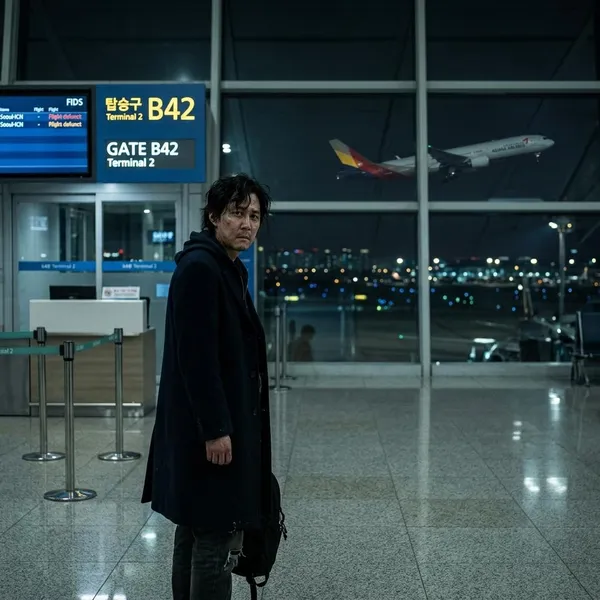
The squid game season 1 ending explained simply: Gi-hun wins the money, but he does not escape the game's damage. Sang-woo dies, Gi-hun loses his mother, Il-nam is exposed as one of the people behind the games, and the airport scene shows Gi-hun choosing to fight the system instead of quietly moving on.
How Squid Game Season 1 ends
The finale works on two levels at once. If you only want the plot answer, Gi-hun survives the final round and becomes the winner. If you are trying to understand why the ending feels so bleak, the key is that every "win" arrives too late, costs too much, or reveals something worse underneath.
Gi-hun defeats Sang-woo in the final game
Gi-hun defeats Sang-woo physically, but the scene is not framed as a clean heroic victory. It is the collapse of a childhood friendship under debt, fear, grief, and survival pressure.
The most important detail is that Gi-hun stops short of killing him. He tries to use the rule that would end the game if both finalists agree, which shows he has not fully accepted the game's logic. The system wants the final player to win by becoming ruthless; Gi-hun wins while still trying, however late, to choose mercy.
Sang-woo takes his own life
Sang-woo kills himself because he cannot see a livable future after what he has done. He has betrayed Ali, killed Sae-byeok, and destroyed the successful image his mother and neighborhood believed in.
His final request, asking Gi-hun to help his mother, keeps the scene from being only about defeat. Sang-woo is responsible for his choices, but he is not written as a cartoon villain. He is a man who has crossed too many lines and can only imagine one last act that gives his death a purpose.
Gi-hun returns home to find his mother dead
This is where Gi-hun's victory becomes emotionally hollow. He entered the games partly because he needed money to help his mother, but by the time he returns, the money can no longer do the one thing he wanted most.
Il-nam reveals his role in the games
Il-nam's reveal changes the whole season in hindsight. Player 001 was not just a fragile old man who happened to last longer than expected; he was one of the people behind the competition.
The twist hurts because Gi-hun thought he had found another victim. Instead, he had been emotionally close to one of the architects of the nightmare.
Gi-hun turns back before boarding the plane
Gi-hun turns back because he sees the recruiter targeting another desperate man. To anyone else, it might look like a strange street game. To Gi-hun, it is the first step toward the same trap that pulled him in.
What the Il-nam twist reveals
The Il-nam twist is not only a surprise identity reveal. It explains the worldview behind the games: people with extreme wealth have become so detached from ordinary suffering that they can turn desperation into a private spectacle.
Player 001 helped create the games
Player 001 helped create the games, which means he was never in the same position as the other contestants. He entered with knowledge, power, and likely protection, while everyone else entered because they were cornered by debt and desperation.
He joined because wealth no longer excited him
Il-nam says he joined because ordinary pleasure had stopped meaning anything to him. That explanation is meant to sound empty, not sympathetic.
The contrast is brutal: the contestants are fighting to escape ruin, while Il-nam is chasing feeling. For a regular viewer, that difference is the easiest way to read the twist. The poor enter because they have no good options; the ultra-rich enter or watch because they have too many options and no moral center left.
The organizers treated suffering as entertainment
The organizers do not see the players as full human beings. They watch them, bet on them, rank them, and package their fear as a premium event.
- The VIPs speak like gamblers, not witnesses to murder.
- The sets make death look colorful, controlled, and theatrical.
- The masks turn staff into functions instead of people.
His final bet tests Gi-hun's faith in people
Il-nam's last bet asks whether anyone will help a freezing man outside before midnight. It is a small scene, but it carries the argument of the whole season.
Il-nam believes people are selfish when stripped down to their real nature. Gi-hun has seen plenty of evidence for that, but he still wants to believe decency can survive. When help finally comes, it does not magically redeem the world. It simply proves Il-nam is not completely right, and that matters because Gi-hun needs some reason to resist rather than give in to cynicism.
Why Gi-hun avoids the prize money
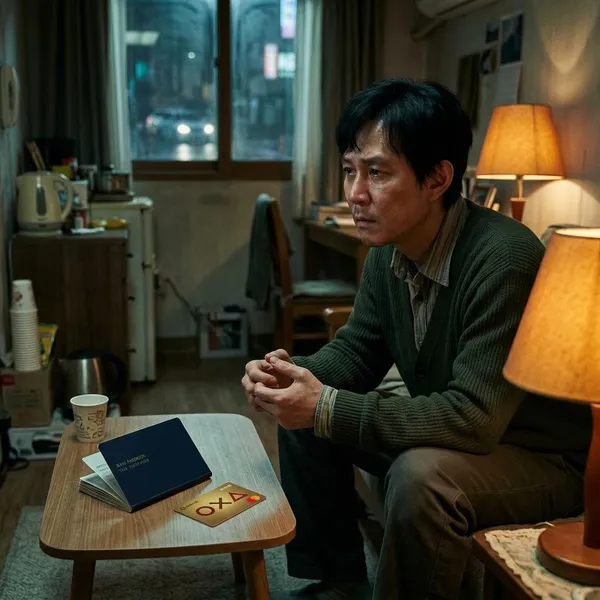
Gi-hun avoids the prize money because it feels contaminated. On paper, 45.6 billion won should solve his problems. In his mind, it is tied to every player who died, every compromise he made, and the fact that his mother was already gone when he came home.
He feels guilty for surviving
Gi-hun's survivor's guilt is central to his behavior after the games. He lived while hundreds of others died, including people who trusted him or deserved a chance as much as he did.
He also knows he did not survive through pure virtue. Luck, help, hesitation, and other people's deaths all played a role. Spending the money casually would feel like accepting a reward built from their loss.
His mother's death makes the win meaningless
His mother's death removes the clearest purpose the prize could have had. Gi-hun needed money for her care, but the game delays him until the help arrives too late.
The money reminds him of the dead players
The prize total rose as players died, so the money is impossible for Gi-hun to separate from death. It is not just cash in an account; it is the scoreboard of the massacre he survived.
When he later helps Sae-byeok's brother and Sang-woo's mother, he is not making the money clean. He is trying to use part of it in the least selfish way he can. That distinction matters: the show is not saying charity erases the horror, only that Gi-hun is searching for a less corrupt use of the prize.
He remains trapped by the games emotionally
Gi-hun has left the arena, but the arena has not left him. His grief, numbness, avoidance, and obsession show that survival is not the same as recovery.
Why Gi-hun does not board the plane
Gi-hun does not board the plane because he realizes the games are still active. The recruiter's return gives him a clear choice: go to his daughter and try to rebuild privately, or turn back because he now knows other people are being pulled into the same death system.
The scene is not cleanly comforting. It is brave, but it is also sad. Gi-hun chooses resistance, and the cost is another delay in becoming the father he wants to be.
He sees the recruiter targeting another player
The recruiter's ddakji game is the trigger. Gi-hun recognizes it instantly because he once stood in the same position: broke, humiliated, and vulnerable to an offer that seemed strange but possible.
He learns the games are still running
The recruiter proves the organization did not end when Gi-hun won. It still has money, staff, methods, and confidence.
That changes the meaning of his victory. He did not defeat the system; he only survived one cycle of it. Once he understands that, private escape becomes harder to justify.
He refuses the Front Man's order
When the Front Man tells Gi-hun to get on the plane, Gi-hun refuses. It is a quiet act, but it is one of his clearest moments of agency.
The Front Man represents the path of surrender from the other side: a former winner who now serves the machine. Gi-hun's refusal says he will not become another silent survivor who accepts the rules after the fact.
He chooses resistance over reunion
Gi-hun chooses resistance over immediate reunion with his daughter. That choice can be read as heroic, irresponsible, or both, which is why the ending keeps bothering people.
What the Season 1 ending really means
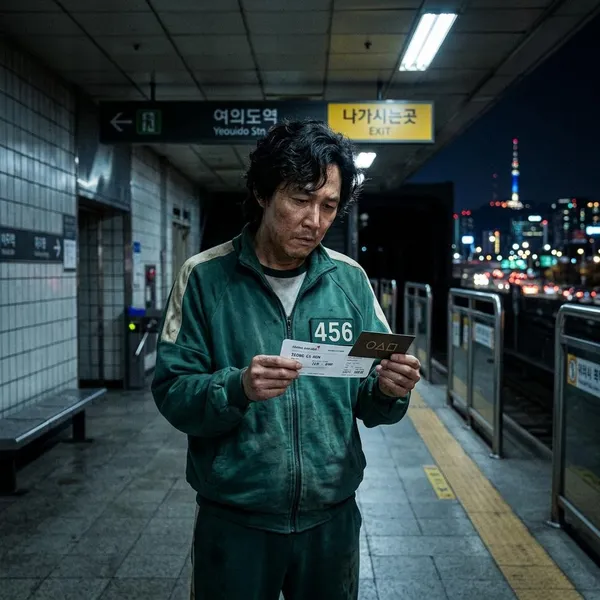
The ending means that winning inside a cruel system is not the same as being saved from it. Gi-hun gets the prize, but the game keeps its deeper power over him: trauma, guilt, knowledge, and responsibility.
The finale also pushes back against two easy readings. It is not saying that all people are monsters, because Gi-hun still believes compassion exists. It is not saying money means nothing, because poverty is what made the players vulnerable. The sharper point is that money without humanity becomes monstrous.
Wealth turns human suffering into entertainment
The rich organizers and VIPs are so insulated that they can watch desperate people die as if it were sport. The games are not only violent; they are curated, decorated, and sold as an experience for people who no longer feel the weight of ordinary human pain.
Winning cannot undo trauma
Gi-hun's victory cannot bring back the dead, save his mother, or erase what he had to witness. The prize changes his bank account, not his memories.
Gi-hun preserves his faith in humanity
Gi-hun does not come out of the season innocent, but he does come out still able to believe people can choose decency. That separates him from Il-nam, who uses human selfishness as an excuse for cruelty.
The freezing man scene is small on purpose. One person being helped does not prove the world is good. It proves the world is not only what Il-nam says it is, and that small difference is enough for Gi-hun to keep fighting.
Survival becomes a reason to fight back
By the final scene, Gi-hun's survival has become a burden he has to use. He cannot undo the games, but he can refuse to let the organization keep operating without challenge.
That is why the ending is unresolved rather than unfinished. The contest is over, but the moral conflict has just become clear. Gi-hun is no longer trying only to live after the game; he is deciding what surviving it now demands from him.
Conclusion
Gi-hun wins, but the finale makes sure the victory never feels like rescue. Sang-woo's death, his mother's loss, Il-nam's confession, and the recruiter's return all point to the same practical reading: the game took more than it gave, and Gi-hun can only move forward by refusing to treat survival as the end of his responsibility.