
The clearest manifest ending explained answer is this: Flight 828 was not solved as a normal sci-fi mystery, but as a spiritual judgment story. Cal's sacrifice brings the passengers back to the plane, the unredeemed fail, the survivors stand together, and the plane returns them to 2013 with their memories intact.
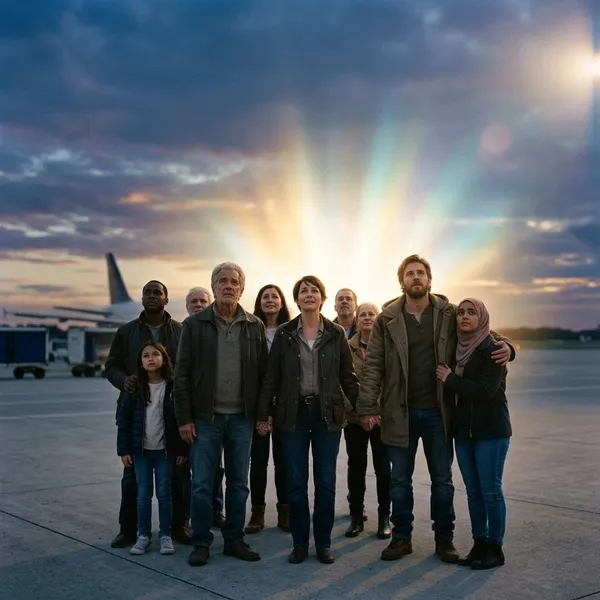
How Manifest ends
Manifest ends by turning the Death Date into a final test. The passengers do not just escape disaster; they are judged on what they did with the Callings, whether they changed, and whether they can stand together when fear takes over.
If you watched mainly for the mystery-box answer, the finale may feel less mechanical than expected. If you watched for Ben, Michaela, Cal, Saanvi, and the other passengers' emotional arcs, the ending is much clearer: the show cares more about who they became than about a technical explanation of turbulence, time travel, or a portal.
Cal sacrifices himself to summon Flight 828
Cal's sacrifice is the trigger for the final stage of the story. He understands that his connection to the Callings and the Death Date is not accidental, so he steps into that role instead of waiting for someone else to solve it.
That choice completes his arc neatly. Cal begins the series as the child everyone tries to protect, but he ends it as the person willing to give himself up for the passengers. The important detail is not that he has special power; it is that he uses his connection selflessly.
The passengers board for their final judgment
When the passengers reboard Flight 828, the plane stops being just the place where the mystery began. It becomes the place where their choices are weighed.
The Callings matter here because they were never only clues. Each one pushed the passengers toward rescue, confession, courage, or sacrifice. Some responded with humility; others used fear, denial, or self-interest to protect themselves. By the finale, those patterns are no longer background details. They decide who survives.
Angelina and ten others turn to ash
Angelina turns to ash because she fails the final judgment. Ten other passengers meet the same fate, which makes the scene more than a personal punishment for one villain.
Her ending is pointed because she spends so much time claiming divine authority while hurting people around her. The finale rejects that completely. The difference between Angelina and the survivors is not that the survivors were innocent; it is that they showed remorse, accepted help, or tried to repair what they damaged.
The survivors defeat the Dark Angel together
The Dark Angel is best understood as a final force of judgment, not a normal monster that can be beaten in a physical fight. Ben, Michaela, and the others survive by making a case for mercy: the passengers saved lives, changed through pain, and became more than their worst moments.
- Not perfection: several survivors made serious mistakes.
- Not luck: survival is tied to growth and accountability.
- Not individual heroics only: the group's unity matters.
The plane returns them to 2013
After judgment, Flight 828 lands at JFK on April 7, 2013. For the rest of the world, the plane simply arrives on schedule. For the surviving passengers, the missing years still happened because they remember them.
This is the part that makes the ending feel like mercy rather than a clean erase. Grace is alive again, Zeke is alive, Cal is a child again, and the passengers have the chance to avoid the losses they already lived through. The catch is that they cannot unknow what those losses taught them.
Why Flight 828 returns to 2013
Flight 828 returns to 2013 because the finale gives the survivors a second chance at the moment their lives originally split apart. The reset is not meant to say the missing years were fake. It says the passengers passed through them, changed, and were allowed to begin again with that knowledge.
The original timeline gets a second chance
The original timeline is reopened, but it is not restored in a blank way. The passengers return to the same arrival date with information they never had the first time.
That matters for different characters in different ways. Ben can love Grace with the memory of losing her. Michaela can choose her future with Zeke without the same hesitation. Saanvi can carry her hard-earned honesty into a life that has not yet gone wrong in the same way.
The passengers keep their memories
The surviving passengers remember the lost timeline, and that is the detail that keeps the finale from feeling cheap. Their grief, guilt, love, and growth remain part of them.
Their lost loved ones return
The reset brings back people who died in the missing-years timeline, including Grace and Zeke. Those reunions are the emotional reward of the ending, especially for Ben and Michaela.
Still, the show does not make those relationships automatically perfect. The loved ones return, but the passengers are the ones who carry the memory of what went wrong before. That creates a quieter responsibility: love better, speak sooner, and do not waste the life that was restored.
Their growth still matters
Their growth matters because it is the one thing the reset does not remove. Time goes back, but the survivors do not become their old selves again.
That is important if you are trying to decide whether the finale "erases" the series. It erases the public timeline for everyone else, but it does not erase the inner journey for the passengers. They return with the emotional cost still inside them.
Their future choices can now change
The passengers can make different choices after landing in 2013. That is the practical point of the second chance.
- Ben's path: he can be present with Grace and his family before grief hardens him.
- Michaela's path: she can move toward Zeke with clarity instead of waiting until loss teaches her what matters.
- Saanvi's path: she can use what she learned without isolating herself through guilt.
- The other survivors: they can avoid the choices that once fed fear, selfishness, or denial.
For a viewer rewatching the finale, this is the hopeful edge of the ending. The show closes the Flight 828 mystery, but it leaves the characters with real decisions still ahead.

What really happened to Flight 828
Flight 828 entered the divine consciousness, a realm outside normal time where past, present, future, memory, and judgment can overlap. The series uses scientific language at points, especially through Saanvi's research, but the final answer is spiritual rather than scientific.
The passengers entered the divine consciousness
The divine consciousness explains why the passengers could receive impossible knowledge. They were connected to a realm where normal time does not work the way it does in everyday life.
That is why the series can mix visions, mythology, symbols, and warnings without reducing them to one laboratory answer. Saanvi's science helps the characters investigate the phenomenon, but it never fully contains it.
The Callings came from outside normal time
The Callings came from beyond linear time, which is why they could point toward events that had not happened yet or reveal truths the passengers could not have known.
They were not always clear instructions. Sometimes they were images, sounds, feelings, or fragments that forced the passengers to choose whether to act without certainty. That uncertainty is part of the test: compassion counts more when the answer is not handed over neatly.
Their disappearance became a shared test
The disappearance was a collective trial, not just a private curse for each passenger. The group's choices affected the group's fate.
This is why Ben and Michaela's efforts to keep the passengers connected matter so much. In a lower-stakes version of the story, each passenger might simply be judged alone. In Manifest, the community itself becomes part of the answer: fear spreads, mercy spreads, and survival depends on what the passengers become together.
The Glow returns them after judgment
The Glow functions as the threshold between ordinary reality and the divine consciousness. In the finale, it is the way the survivors are released from judgment and returned to the original landing date.
The show never treats the Glow like a machine with clear operating rules, so it is better read as a sign of transition and mercy. When the survivors pass through it, they are not just escaping death. They are being restored.
What the Manifest ending really means
The ending means redemption matters more than a spotless record. The passengers are judged, but the judgment looks at growth, accountability, sacrifice, and mercy, not just a list of every wrong thing they ever did.
Redemption matters more than perfection
The survivors are not perfect people. Ben, Michaela, Saanvi, and others all carry guilt, fear, or regret, but the finale does not define them only by their failures.
Angelina is the contrast. Her problem is not one bad choice; it is her refusal to stop justifying harm. The survivors are flawed, but they move toward repentance and repair. That is the moral line the finale draws.
Mercy can outweigh past guilt
The ending argues that mercy can outweigh guilt when guilt leads to real change. The passengers are not declared innocent; they are treated as redeemable.
This is also why the reset does not feel like everyone simply "got away with it." The survivors keep the memory of what they did, what they lost, and who they hurt. Mercy gives them another life, but memory keeps that mercy from becoming weightless.
Growth survives the timeline reset
Growth survives because the passengers remember. Their circumstances return to 2013, but their character development does not reset with the calendar.
For anyone bothered by reset endings, this is the key boundary. The outside world may not remember the missing years, but the people who lived them are permanently changed. The story's consequences move from public history into private responsibility.
A second chance still carries responsibility
A second chance in Manifest is not just a reward; it is an obligation. The passengers now know what delay, selfishness, secrecy, and fear can cost.
That makes the final airport scene more complicated than simple happiness. Ben, Michaela, Saanvi, and the others get restored lives, but they also get the burden of using those lives better. The ending's real question is not whether they survived. It is whether they will live as people who deserved to.

Conclusion
Manifest ends by choosing grace over a cold puzzle solution: Flight 828's passengers entered the divine consciousness, faced judgment, and the survivors returned to 2013 with the burden and gift of memory. The reset works because it does not pretend the pain never mattered; it gives the characters a chance to prove their growth in the life they almost lost.