
If you want the sopranos ending explained in the clearest possible way, the final scene strongly points to Tony Soprano being killed, but it refuses to show the murder in a normal TV-finale way. The important clues are not one hidden detail but the pattern: Tony's point of view, the diner bell, the Members Only man, Bobby's warning, and the sudden cut to black all work together.
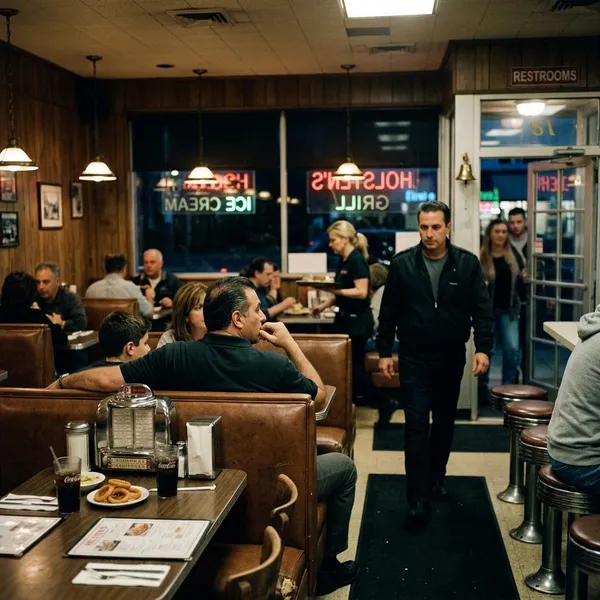
How the final diner scene unfolds
The Holsten's scene looks ordinary at first: a family dinner, a jukebox, onion rings, people walking in and out. That plain setting is the trick. The scene trains you to watch small movements, because in Tony's life danger rarely announces itself with dramatic music or a clear villain.
Tony waits for his family
Tony arrives first, chooses Journey's "Don't Stop Believin'," and waits in the booth. It could be a normal family moment, but Tony never looks fully settled. He keeps noticing the door, the room, and the people around him.
That is the first thing to check if you are rewatching the scene: Tony is not behaving like a man who has escaped danger. He is trying to have a quiet meal, but the life he chose has made quiet feel temporary.
Each bell shifts to Tony's view
The diner bell is more than background sound. When the door opens, Tony looks up, and the editing often moves into what he sees. After this happens a few times, the viewer learns the rhythm without being told: bell, Tony's reaction, Tony's point of view.
This matters because the ending breaks that exact rhythm. If you are watching casually, the blackout feels shocking. If you are watching the editing, it feels more specific: the expected view from Tony's eyes is replaced by nothing.
The Members Only man enters
A man in a Members Only jacket walks in, sits at the counter, and looks toward Tony. The scene gives him just enough attention to make him suspicious, but not enough to turn him into an obvious movie assassin.
That balance is why he works. A loud, threatening figure would make the ending too easy. A completely ignored extra would not create enough pressure. The Members Only man sits in the uncomfortable middle.
Meadow struggles to park
Meadow's parking problem stretches the scene almost painfully. On a first watch, it can feel like simple suspense. On a rewatch, it feels like timing: the family is almost complete, but not quite.
Her delay also keeps Tony exposed for a few extra seconds. The point is not that Meadow causes anything; it is that ordinary life keeps moving awkwardly while something terrible may already be in motion.
Tony looks up as the screen goes black
The final door bell rings, Tony looks up, and the show withholds the shot we expect. No Meadow reaction. No gun. No scream. Just black, with the sound cut off as abruptly as the image.
- The bell repeats the pattern the scene has already established.
- Tony looks up, setting up another point-of-view shot.
- The expected view never arrives.
- The blackout takes the place where Tony's perception should be.
What clues suggest Tony dies?
The strongest death reading comes from stacking the clues in order of importance. Start with the editing, then look at the suspicious movement in the diner, then add the earlier dialogue and mob-movie echoes. No single clue has to carry the whole argument by itself.
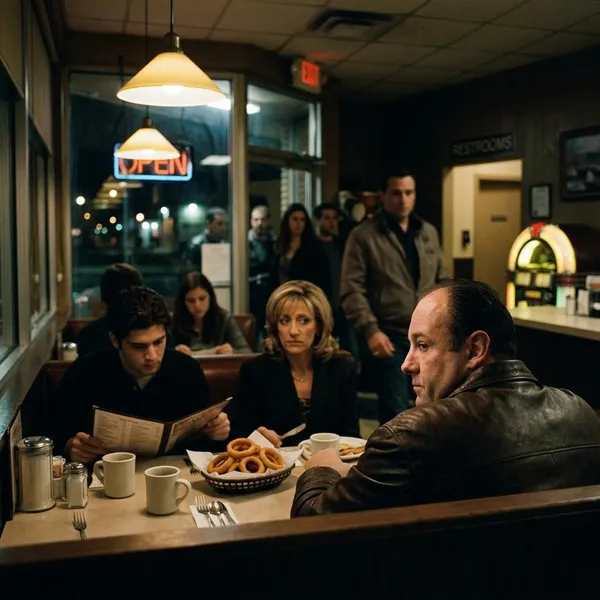
The Members Only man watches Tony
The Members Only man is suspicious because the camera asks us to notice him. He glances toward Tony, stays close enough to matter, and moves with a calmness that feels deliberate rather than casual.
His bathroom trip echoes The Godfather
His walk to the bathroom is hard to separate from The Godfather, where Michael Corleone retrieves a hidden gun from a restaurant bathroom before a killing. The Sopranos knows mafia-film language too well for that movement to feel accidental.
The echo does not prove every practical detail of the hit. It does, however, tells viewers what kind of danger the scene is invoking: a close-range restaurant murder hidden inside a normal meal.
The editing establishes Tony's point of view
This is the most useful clue if you are trying to decide what the ending actually means. The finale repeatedly links the bell, Tony's face, and Tony's view. When the final reverse shot becomes blackness, the scene appears to cut off Tony's awareness rather than simply end the episode.
Bobby foreshadows a silent death
Bobby's earlier line, "You probably don't even hear it when it happens," becomes chilling in the finale. Tony does not hear a shot. The audience does not hear one either. The moment simply disappears.
That makes the final cut feel like a payoff, not just a stylistic trick. The show has already told us what sudden death might feel like in this world, and then it gives us that experience from the inside.
The final blackout replaces Tony's view
The blackout is not a fade-out, a pause, or a normal ending shot. It lands exactly where Tony's point of view should be. That placement is the reason the death interpretation remains stronger than the idea that "nothing happened."
- First check: the final cut interrupts Tony's established point of view.
- Second check: the Members Only man is positioned as a live threat.
- Third check: Bobby's line gives the silence a clear meaning.
- Weak reading: treating the blackout as random ambiguity ignores how carefully the scene is built.
What does the Members Only man represent?
The Members Only man works because he can be read in two ways at once. He may be the person who kills Tony, but he also represents the kind of danger Tony has made normal around himself. That double meaning is more useful than trying to turn him into only a symbol or only a plot device.
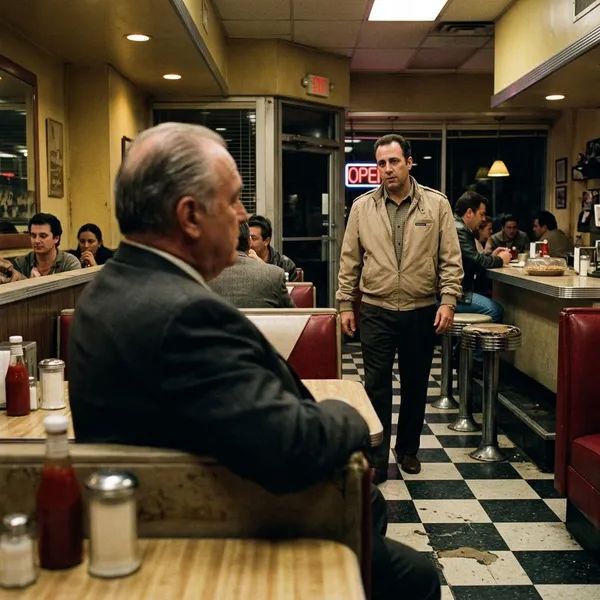
A possible hitman
As a practical plot reading, he fits the role of a hitman. He is close to Tony, he watches him, he moves toward the bathroom, and he does not draw attention to himself. That last part is important: an ordinary-looking man is more believable in this scene than a dramatic villain would be.
If you are choosing between "random customer" and "possible assassin," the scene pushes harder toward the second option. It does not confirm him, but it frames him with too much purpose to ignore.
Tony's constant paranoia
The man also reflects Tony's state of mind. By the final season, Tony's fear is not imaginary, but it is constant. He has real enemies, and he has trained himself to scan every room as if someone might be waiting for him.
That is why two viewers can feel the scene differently. A casual viewer may ask, "Was that man going to kill him?" A viewer focused on Tony's psychology may feel something broader: this is what every public place has become for Tony.
The danger hiding in ordinary life
The diner should be safe. Carmela is there, A.J. arrives, Meadow is outside, and the music is familiar. The horror of the scene is that none of that protects Tony.
That is one of the final moral points of the show. Tony tried to keep family life and criminal life in separate boxes, but the ending collapses them. The possible hit does not come in a warehouse or during a mob meeting. It comes at dinner.
What has David Chase said about the ending?
David Chase has resisted giving the kind of simple answer that would turn the finale into a solved trivia question. Still, his comments over the years have often made the death reading harder to dismiss. The safest way to treat his remarks is this: they support the connection between the blackout, death, and uncertainty without turning the scene into a plain on-screen execution.
He has avoided a simple plot answer
Chase has often pushed back against reducing the finale to "Did he get shot or not?" That does not make the question pointless. It means he wanted the ending to work as an experience, not just as a spoiler.
The better approach is to ask what the scene makes the viewer feel and how it creates that feeling. On that level, the finale puts us inside Tony's last possible moment of awareness, or at least inside the fear that such a moment could arrive anywhere.
He has connected black with death
Chase's later comments have repeatedly fueled the idea that blackness in the ending is tied to death or finality. He has not always framed this as a clean official confirmation, but the association lines up with what the scene already suggests.
He has stressed life's uncertainty
Chase has also emphasized uncertainty, which fits Tony's entire life. Tony never gets to know which meal, meeting, or doorway might be the dangerous one.
Uncertainty does not automatically mean Tony survives. In this ending, uncertainty is the atmosphere around the likely event. The viewer is made to wait, scan, and then lose the image before getting comfort or confirmation.
His comments support more than one reading
More than one reading is possible, but not every reading is equally supported."Tony dies" has the strongest combination of visual evidence, earlier foreshadowing, and thematic fit. "Tony keeps living with paranoia" also works as a thematic reading, especially if you focus less on plot and more on mood.
The weakest reading is that the cut to black is meaningless or just a prank on the audience. The scene is too controlled for that. Even when Chase protects the ambiguity, the craft points toward sudden death and the cost of Tony's life finally reaching the family table.
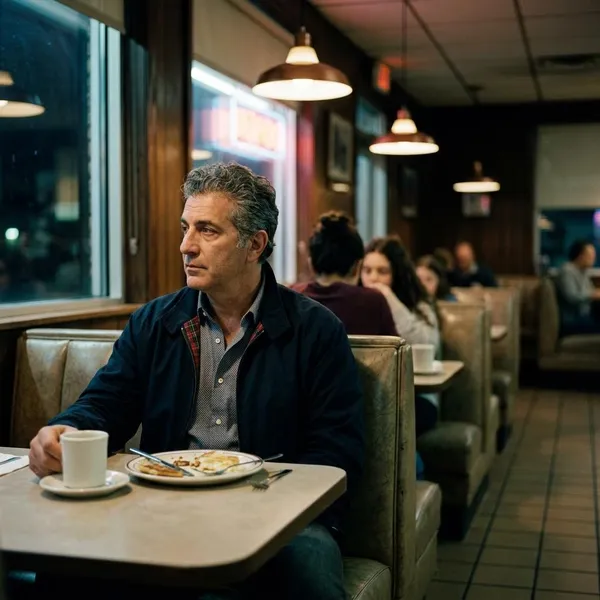
Conclusion
The most convincing reading is that Tony dies at the instant the screen cuts to black, but the ending is powerful because it makes you feel the loss of awareness instead of showing the mechanics of a hit. If you are deciding what to believe, give the most weight to the editing pattern and the blackout, then use the Members Only man, the bathroom echo, Bobby's line, and Chase's comments as supporting clues. The final scene leaves just enough space for debate, but it does not feel empty; it feels like the life Tony built finally closing in without warning.