
The cleanest way to read the squid game season 3 ending explained is this: Jun-hee's baby wins as Player 222 because Gi-hun chooses a valid sacrifice instead of killing her. Myung-gi's fall happens too early to count, Gi-hun activates the final round himself, and the ending turns the game's own rules against its cruelest assumption: that everyone will choose survival over humanity.
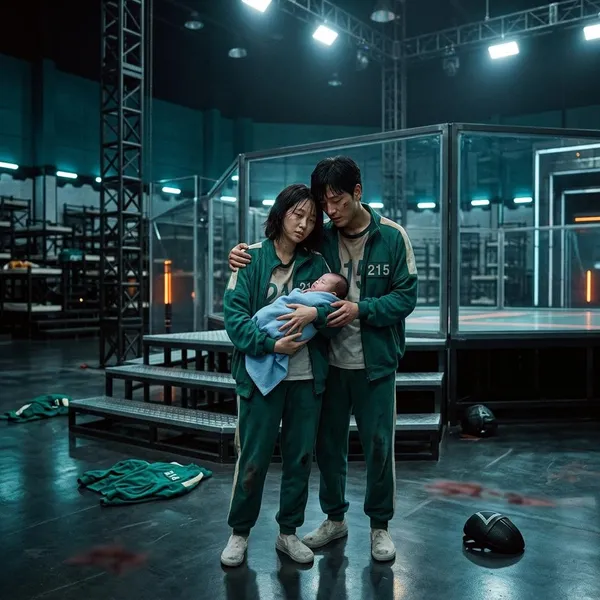
How the baby wins Squid Game
The baby wins because the final round depends on one technical detail: the stage has to be activated before an elimination counts. If you watched the finale mainly for the plot mechanics, this is the first thing to check. Myung-gi dies before the button is pressed, so the game still needs one official elimination.
That leaves Gi-hun with the ugliest possible choice. He can kill a newborn and survive, or he can make himself the final valid elimination. He presses the button, gives up his life, and Player 222 becomes the official winner.
- Jun-hee dies, but her baby remains in the game as Player 222.
- Myung-gi falls before the final stage is officially activated.
- The game does not count his death as the required elimination.
- Gi-hun presses the button and starts the round properly.
- Gi-hun sacrifices himself, leaving the baby as the last surviving player.
The baby keeps Jun-hee's player number
Player 222 stays active after Jun-hee's death, which is both practical and horrifying. To the organizers, the baby is just a continuation of the same player slot; to the audience, that number carries Jun-hee's last act of protection into the final round.
Myung-gi falls before the round begins
Myung-gi's fall does not count because the button has not been pressed yet. The final stage is not officially underway, so his death cannot satisfy the game's elimination requirement.
This is not just a rule twist. If his fall counted, Gi-hun could survive without making the defining moral choice of the finale. By making the death invalid, the show forces the ending away from "who won the fight?" and toward "what kind of person will Gi-hun be when there is no clean option?"
Gi-hun activates the final round
Gi-hun presses the button because waiting would not free the baby from the game. The system still needs an ending, and he knows the only remaining power he has is deciding whose life will be used to complete it.
Gi-hun gives up his life
Gi-hun's death is deliberate, not a last-second accident. He chooses to die because the alternative is surviving by murdering a helpless child, which would make him exactly the kind of person the game is designed to produce.
That is why the ending feels tragic but not empty. He cannot destroy the whole system in that moment, but he can refuse to let it define winning for him.
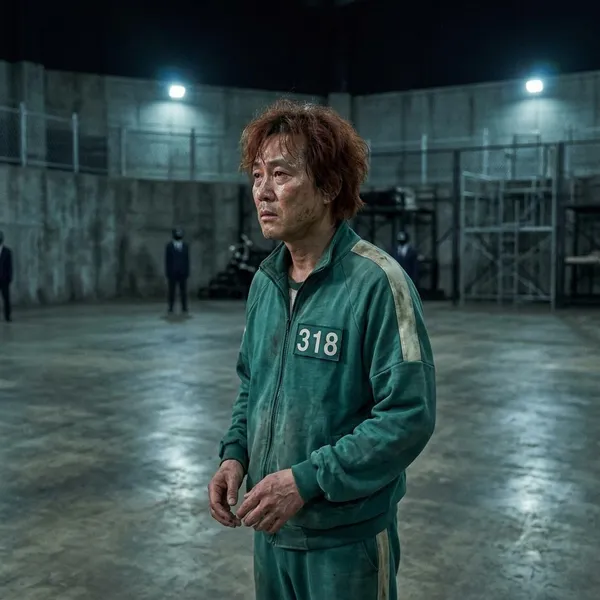
Why Gi-hun chooses to die
Gi-hun dies because saving the baby is the only choice that lets him remain human. The finale makes the moral line unusually clear: this is not a duel between equal players, and it is not self-defense. It is an adult being asked to kill an infant for money.
If you are reading the ending emotionally rather than mechanically, Gi-hun's choice is the completion of his character arc. He has failed people before, especially as a father, but here he acts with total responsibility when it costs him everything.
He refuses to kill the baby
The simplest reason is also the most important: Gi-hun cannot kill a newborn. The game tries to turn the baby into a rival, but Gi-hun sees her as a life that needs protection, not as an obstacle between him and the prize.
He rejects the Front Man's beliefs
Front Man believes the games reveal what people really are: selfish, frightened, and willing to trade morality for survival. Gi-hun's sacrifice is his answer. He chooses compassion when there is no personal reward left, which makes the choice harder for Front Man to dismiss as naive talk.
This is why the Front Man's later actions feel shaken rather than fully redemptive. Gi-hun has not magically changed him into a good person, but he has damaged the certainty behind his worldview.
He chooses humanity over survival
Gi-hun is not choosing death because life has no value. He is choosing death because living after killing the baby would be a corrupt kind of survival. The finale draws a line between being alive and still being able to live with yourself.
He completes his journey as a father
Gi-hun's story has always carried guilt around fatherhood. He loves Ga-yeong, but love alone was never enough when his actions were unreliable. In the finale, he protects a child who is not his own, and that gives his final act a painful sense of repair.
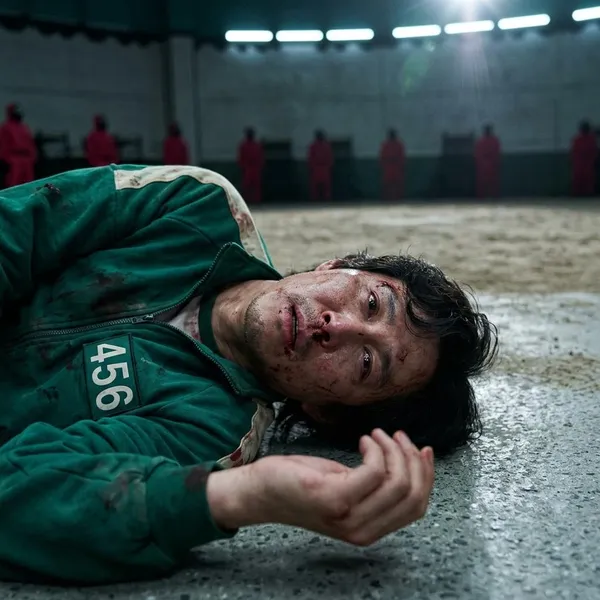
What Gi-hun's final words mean
Gi-hun's final words — "We are not horses. We are humans. And humans are…" — are aimed at the whole logic of the games. The VIPs watch players as if they are racehorses: numbered, bet on, and discarded after the entertainment ends.
He never finishes the sentence, but his action finishes it for him. Humans are capable of conscience. Humans can refuse cruelty. Humans can choose another person's life over their own advantage.
The players are people, not horses
The horse comparison cuts directly into the show's oldest image of the rich gambling on the desperate. Gi-hun is saying that poverty, debt, and fear do not make the players less human. They were never pieces of entertainment, even when the system dressed their suffering up as a contest.
Human life cannot be reduced to a game
The ending exposes how absurd the game's definition of victory really is. A newborn is declared the winner because the rules allow it, while the only morally meaningful act is Gi-hun's refusal to treat her as a competitor.
Compassion survives even inside the system
The finale does not pretend kindness destroys the machine overnight. Jun-hee, Gi-hun, No-eul, and even Front Man in a limited way make choices that interrupt the system rather than erase it.
That makes the ending bittersweet. The games may still exist, but the people inside them are not fully emptied out by them.
What the baby's victory represents
The baby's victory represents the future surviving through other people's sacrifice. On the surface, it is strange for a newborn to win a death game. Symbolically, it is very direct: the one person with no greed, no strategy, and no guilt is the one who makes it out.
Hope for the next generation
The baby is the finale's clearest sign that the story has not collapsed into total despair. Her survival does not make the ending happy, but it gives the tragedy a direction: something innocent is carried forward instead of being consumed by the game.
A future protected through sacrifice
Jun-hee protects the baby before Gi-hun does, and Gi-hun completes that protection at the cost of his life. The future survives here not because the world becomes fair, but because specific people choose responsibility when it would be easier to turn away.
The opposite of Myung-gi's greed
Myung-gi is the dark mirror of the baby's meaning. He is her biological father, but he treats her as expendable once money is at stake. Gi-hun has no blood claim, yet he acts like the real guardian.
That contrast keeps the ending from becoming a simple "family" message. The show is more interested in chosen responsibility than biology. Care has to be proven by action.
Gi-hun's restored faith in humanity
Gi-hun does not die believing the world is fixed. He dies proving that one humane choice still matters inside a rotten system. That is a smaller victory than destroying the games, but in this story, it is not a meaningless one.
What happens after the final game
The aftermath shows what Gi-hun's sacrifice changes and what it cannot change. The baby is saved, some families receive a form of closure, and Front Man behaves with more emotion than he wants to admit. At the same time, the final scene suggests the larger machinery behind the games has not simply disappeared.
The Front Man rescues Player 222
Front Man carries Player 222 out after Gi-hun dies. It is a humane act, but not a full redemption. He has still overseen enormous cruelty; the rescue mainly shows that Gi-hun's sacrifice has cracked his certainty, at least when faced with an innocent child.
Jun-ho receives the baby and prize money
Jun-ho receives the baby along with Player 222's winnings, which leaves him with responsibility rather than clean closure. He does not get to undo the games or fully resolve his brother's choices. He gets a living child who now needs protection outside the arena.
The money matters, but the more important detail is the transfer of care. The baby's survival cannot end with the winner announcement; someone in the outside world has to choose what to do with that life.
Ga-yeong receives Gi-hun's winnings
Ga-yeong receives Gi-hun's belongings and money, which gives her truth but not comfort. The scene does not turn his absence into something painless. It simply makes clear that he did not forget her, even though the truth reaches her too late.
No-eul saves Gyeong-seok
No-eul saving Gyeong-seok is another example of limited resistance. She cannot dismantle the whole operation, but she can pull one person out of it. His survival, and the glimpse of his daughter's future, gives that subplot a small but real piece of hope.
Cheol reunites with his mother
Cheol's reunion with his mother quietly completes Sae-byeok's old wish. It is brief, but it matters because it shows care lasting beyond the person who first fought for it. Not every loss is repaired, yet one family thread finally reaches the place Sae-byeok wanted it to reach.
Conclusion
The ending works best when you separate the official result from the moral result: Player 222 wins the game, but Gi-hun wins the argument. His final choice does not destroy the system or make the world safe, yet it proves the one thing the games keep trying to deny — that a person can still choose dignity when survival is no longer innocent.