
The ending of Mad Men is not saying Don Draper simply becomes enlightened or simply sells out. The clearest reading is that Don has a real emotional breakthrough at the California retreat, then turns that feeling into the Coca-Cola "Hilltop" ad. His smile matters because it holds both things at once: peace, recognition, and the old advertising instinct waking up again.

What happens in the final scene of Mad Men?
Don ends the series sitting in meditation at a retreat in California. He closes his eyes, breathes, smiles, and the show cuts to the famous 1971 Coca-Cola commercial with people singing "I'd Like to Buy the World a Coke." The cut strongly implies that Don returns to advertising and creates the ad from what he has just experienced.
The important thing to check first is not whether Don is "fixed." He is not given that kind of neat ending. The better question is whether the retreat gives him a real feeling he can finally recognize. It does, and that feeling becomes the bridge between Leonard's pain, Don's smile, and the Coke ad.
- Plot answer: Don is at a retreat, meditates, and appears to find the idea for the Coke campaign.
- Emotional answer: Leonard helps Don feel seen at the exact moment he believes he has become unreachable.
- Thematic answer: Don turns private longing into public advertising, which is both moving and unsettling.
Don reaches his lowest point at the retreat
By the time Don reaches California, his usual escape routes have stopped working. McCann makes him feel anonymous, Betty's diagnosis exposes his failure to be consistently present for his children, and his call with Peggy sounds less like a man taking a break than a man disappearing from his own life.
For a first-time viewer, the retreat can seem like a strange left turn. On a rewatch, it feels less random: Don has always run toward new places when his old identity starts to collapse. The difference here is that there is no glamorous reinvention waiting for him. He is just tired, ashamed, and finally still enough to hear someone else's pain.
Leonard's story breaks through his isolation
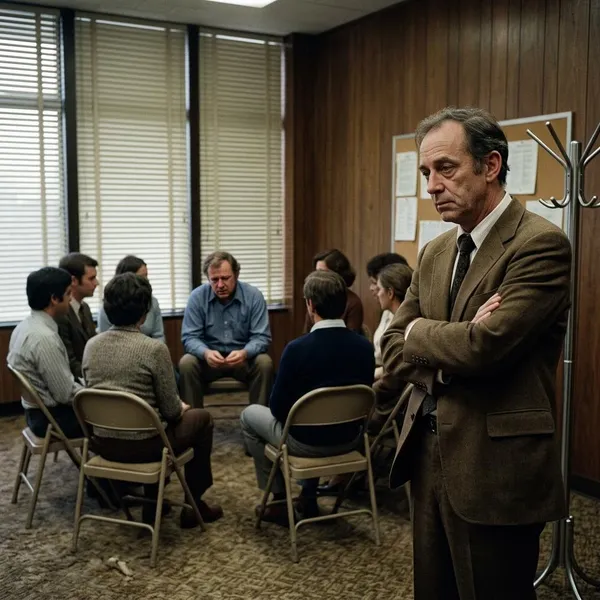
Leonard reaches Don because he describes loneliness without style. He is not charming, sharp, seductive, or dramatic in the way Don often is. He simply says he feels invisible, as if people look at him only briefly before turning away.
That plainness is what makes the scene work. Don has spent years being noticed by everyone and known by almost no one. Leonard gives words to the difference between attention and connection, and Don recognizes himself in it before he can turn the moment into a clever line.
Don meditates before the Coke ad appears
The meditation scene should not be read as a clean spiritual cure. Don's smile can mean calm, but it can also mean recognition: he has found an image, a feeling, a campaign. The show cuts before any boardroom scene because the connection is stronger when the audience has to make it.
Why Leonard changes Don
Leonard changes Don because he gives Don a mirror without knowing it. Don is used to seeing himself through women, clients, rivals, and fantasies of reinvention. Leonard offers something much harder for him to avoid: an ordinary person describing the same wound Don has hidden behind success.
If you are trying to decide which scene matters most in the finale, choose Leonard's group-therapy speech over the final smile. The smile is the result. Leonard's story is the trigger.
Leonard shares Don's fear of being unseen
Don's great contradiction is that he is constantly watched but rarely seen. People admire his work, desire his image, and respond to his confidence, but very few people are allowed near Dick Whitman. Leonard's fear is smaller and quieter on the surface, yet it touches the same buried panic: being present in a room and still feeling emotionally absent.
This is why Don does not respond with advice. He does not pitch Leonard a better version of himself. He breaks down because Leonard has accidentally spoken to the part of Don that status never protected.
The refrigerator story reflects Don's loneliness
Leonard's refrigerator dream is simple: he imagines himself sitting on a shelf while people open the door, look in, and close it again. The image hurts because it makes neglect feel ordinary. Hope appears for a second, then the door shuts.
For Don, that image carries several meanings at once:
- Childhood: affection was unstable, conditional, and often absent.
- Marriage: he wanted intimacy but kept building walls around himself.
- Work: he knew how to get attention, but attention always moved on.
The refrigerator story also explains why the Coke ad is not just a random final reference. Don hears a story about wanting to be chosen, then creates an ad built around shared belonging.
Their embrace gives Don real human connection
The hug matters because Don is not performing in it. He is not seducing, selling, managing, or escaping. For a brief moment, he sees Leonard clearly and lets himself be seen through Leonard's pain.
That does not mean Don becomes a different man forever. A more cautious reading is more convincing: the connection is real, but so is Don's lifelong habit of converting emotion into work. The finale becomes stronger when those two facts are allowed to sit together.
What the Coke ad means
The Coke ad means Don has found a way to translate his deepest longing into a message everyone can understand. The commercial promises harmony, inclusion, youth, peace, and togetherness. It is beautiful because the longing is real, and cynical because that longing is attached to a product.

Two viewer reactions are both reasonable. If you watch the ending for Don's emotional arc, it feels hopeful: he finally touches the connection he has chased for years. If you watch it as a statement about advertising, it feels sharper: even spiritual peace can become a campaign.
It turns Don's longing into a message of belonging
Don has always understood desire because he is ruled by it. He wants home, love, forgiveness, and a version of himself that does not have to be performed. The Coke ad takes that private hunger and gives it a public shape: people on a hill, singing together, sharing one simple promise of unity.
That is why the ad fits Don better than a quiet retirement or a permanent escape from Madison Avenue. His gift is not just writing slogans. It is sensing what people ache for before they can say it clearly.
It transforms real emotion into advertising
The finale's sharpest idea is that advertising does not always work by faking emotion. Often, it works by finding something true and making it sellable. Don's breakthrough with Leonard may be sincere, but the final cut suggests he knows exactly how to package that sincerity.
That makes the ending less like a trick and more like a final thesis for the series. Mad Men has always been interested in the space where identity, commerce, memory, and desire overlap. The Coke ad is the cleanest version of that overlap: a real human need turned into a brand image.
It makes the ending hopeful and cynical at once
A purely hopeful ending would pretend Don is healed. A purely cynical ending would reduce the retreat to a joke. The actual ending is better because it refuses both shortcuts.
The hope is that Don really does feel connected, maybe for the first time in a long while. The cynicism is that his next move is probably to bring that feeling back to McCann and turn it into one of the most famous commercials ever made. For anyone choosing between those readings, the safest answer is not either/or. Don's smile contains both.
Conclusion
Don's final smile works because it is not a simple sign of redemption. Leonard gives him a moment of real connection, and the Coke ad shows what Don does with moments like that: he turns them into language the world can buy. The ending is satisfying because it lets Don grow without pretending he has escaped himself.